Monday, January 17, 2022

Councils [Wilderlands, Errantry]

Preamble: I found these rules buried in an early, early, early His Majesty the Worm draft. I pulled them out and cleaned them up. I think they fit nicely in my Wilderlands/Errantry series since it is obviously inspired by the work there.

If you want to know how I eventually did "social encounters" in His Majesty the Worm, check out my post here.
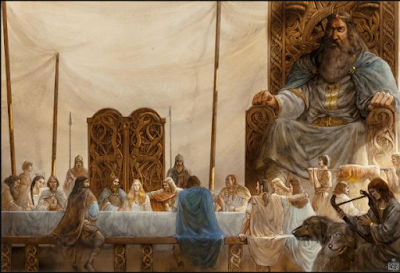
by John Howe

"In a great hall with pillars hewn out of the living stone sat the Elvenking on a chair of carven wood. On his head was a crown of berries and red leaves, for the autumn was come again. In the spring he wore a crown of woodland flowers. In his hand he held a carven staff of oak.

Long and searchingly he questioned the dwarves about their doings, and where they were going to, and where they were coming from; but he got little more news out of them than out of Thorin. They were surly and angry and did not even pretend to be polite."

- The Hobbit

Use these rules when the player heroes are trying to convince a person or group of a particular thing, or when they’re trying to illicit action from another person on their behalf. This could be at a bandit’s war council, at a trial, or at a folkmoot.

When a Council is called, it’s important to determine who the deciding person is. Are you talking to a local leader directly? Are you speaking to stir up the people? Are you trying to convince several people of your plea—perhaps begging help from an assembled gathering of kings from different realms?

The Body of Arguments

At the beginning of a Council, the GM must decide the Body of Argument. These are the reasons why the NPCs are reluctant to accept the PC’s proposal. If the GM can’t think of any arguments against the PC’s plan, the NPCs should merely acquiesce to the PC's course of action.

Most Councils have about three arguments. Councils that are inclined to favor the player heroes might have fewer (as few as one argument, even) and more antagonistic Councils might five (or more!).

An argument is just a short phrase that sums up a major concern. Write each down separately. These arguments are the talking point for the GM’s characters during the Council.

Sample Arguments

  • Helping you would draw the ire of the Winter Witch, which we can ill afford. 
  • This would cost too much money.
  • The time involved would drive me away from my fields during harvest.
  • Your rival has offered to pay me more to do the same for him.
  • This way is too dangerous at this time of year.
  • This is not our affair—we must mind our own business.
  • What you propose would aid our ancient foes, who wrongs against us we have not forgotten.
  • Your errand is impossible. It is a waste of time for me to help one afflicted with madness.
  • This plan would offend the Fair Folk nearby. I’ll have no part of it.
  • I am afraid of the magic that you are said to wield. I’ll not meddle with witches and wizards.
  • I’m a simple man, much to unimportant to actually make a difference. You should ask somebody that can actually help.

GM Note: I find it useful to  jot down the arguments on separate note cards. Then, when a particular argument is “defeated,” I just turn the note card over. It’s nice for me to have these things written down in front of me for easy reference.

A player hero makes their case by role-playing what they’re saying. If the GM determines that this argument is relevant to a particular argument, the player makes a relevant skill test. If the roll is successful, one of the arguments is “defeated.” That particular reasoning no longer troubles the decision maker, or it is no longer deeply relevant to the point at hand. 

When all the arguments are defeated in this manner, the Council will rule in favor of the player heroes.

However, every time a roll is failed, the player hero has failed to make a convincing argument and tested the patience of the decision maker. The Council will decide against the player heroes once a certain number of failed rolls occurs. 

The Council's tolerance for failed arguments is [number of arguments -1]. So if there are three arguments on the table, the Council will move against the PCs after 2 failed rolls.

Focus during Councils

As opposed to battles of arms, Councils do not rigidly track who goes first and who is doing what. The fellowship is typically considered “one side” and any antagonists are considered “another side.” Both have a chance to speak in turn, rebutting or building on arguments as they go. GMs can adjudicate this however makes the most sense, but typically there is only one speaker and one dice roll per side per turn. 

A fellowship might call on the most sociable person—the person with the highest skill—to make almost all of their rolls. In this case, that player must role-play the arguments made. Other player heroes might speak up on the fellowship’s turn when they have what they consider to be a very good argument. When they speak up, they roll instead of the normal speaker. This sort of “butting in” usually happens organically. 

Sometimes only certain player heroes might be the only ones who can plead their case. For example, only one of noble blood might be able to speak at a council of kings. Or only a woman might have the right to speak in the Women’s Circle of the village.

Disposition in Councils

Disposition affects your dice rolls during council. If the argument that you are role-playing would appeal to a particular disposition trait possessed by an NPC, the GM may tell you to roll with advantage. However, if your argument would contradict or displease a particular disposition trait, the GM can tell you to roll with disadvantage.

Consider this example. You are trying to beg support of a king in your errand to rescue your stolen love from a dragon. The king does not like the idea of strangers on his land and is worried that stirring up the dragon will create trouble for his people. The king is chivalrous, stubborn, and materialistic. As you try and convince him of your need, you mention out loud that rescuing the weak from the strong is the responsibility of any true hero. The king, being chivalrous, can’t help but agree. Your roll to convince him is made with advantage. Then, you try to dissuade his fears of the dragon’s wrath, and compare a few fields to the life of an innocent maid. The king does not like to hear of crops and fields burning, being materialistic. This roll is made with disadvantage.

GMs, as always, should grant advantage/disadvantage for good ideas or bad ideas, as they see fit.

Discovering Disposition

When you observe a character in a back-and-forth exchange, you—as the player—should have a fairly good idea about what disposition traits they have. The GM will be hamming these traits up.  

Bidding Lores and Disposition

You can attempt to bid lore to find out more about the characters around you. If the GM accepts that your lore is relevant, they will tell you one of the NPC’s disposition traits. If, for example, you have Court Lore, you can ask “What is one of the local steward’s dispositions?” The GM will consult their notes and say that he is a definitively Greedy man. The player heroes can then use this to their advantage as they try to navigate the world of castle life.

Persuasion Isn’t Domination

One cannot hit the moon with an arrow, no matter their Strength score. Neither can you persuade a random off-the-street NPC that they’ve been transformed into a donkey, that you’re their rightful king in disguise, or that they should cut off their arm for you. Sometimes the players will try to use social skills to convince NPCs of the most unrealistic things. After all, he’s just a stupid NPC and look how many points I’ve put into all these social skills! 

This is not how the game is intended to be played.

Skill rolls help players curry favor with their rhetoric. Even so, the player must first have an oration that is plausible to defeat a particular argument.  

When a player hero tries to use persuasion in scenarios that stretch believability, just say no. The NPC chuckles in amusement at the bizarre nonsense. If they persist, the NPC might get angry—or fear for his life while talking to this dangerous lunatic.

Tuesday, January 11, 2022

Knight, or, rehousing the murder hobo

I had said in a previous post I wasn't going to bark up this tree. Well, here I am, yapping away.

This post was inspired by this Tweet that said that tracking minute pieces of armor seemed boring. Obviously different strokes -> different folks, but I think this could be fun.

This is a continuation of my series about incomparable classes. As before, I've framed the rules here into a GLoG milieu but you can steal the basic concepts pretty easily. 

The Knight

A - Iron Law

B - Iron Word, Squire

C - Ironclad

D - Baron or Knight Errant

The Iron Law

You are a noble. This grants you the Rights of the Lex Ferum. These rights include:

  • The Right of Iron. You may wear armor. No one else can.
  • The Right of Judgment. You may mete out justice to anybody of the peasant class, up to and including execution.
    • Anybody - even peasants - can complain about your behavior to your liege lord. They may choose to censure you if your judgments prove ignoble. 
  • The Right of Challenge. You may challenge another noble to Trial by Iron to settle any matter of honor between you. This may be to first blood, to yielding, or to the death. This includes the right to engage in Jousts.
  • The Right of Conquest. You may claim a single piece of a defeated knight's armor and add it to your Coat of Arms. (The knight can try to ransom the armor back through gold.)
  • The Right of Redemptio. You are immune to all civil penalties except those from your liege lord (or someone higher in the feudal chain). You will almost never be put to death out of hand. You and your armor will almost always be ransomed back to your family.
Iron Word
Gain an extra Conviction slot. When you may swear an oath, fill this slot with an oath to fulfill your Conviction. You may not swear a second oath until your previous oath is fulfilled.

Squire
Your family assigns a squire to you. This counts as a level 0 Mercenary that you don't have to split loot with. 

Whenever you level up, so does your squire. Whenever you return to civilization, you're obligated to knight them and send them on their way. Your family will soon assign you another oaf to train.

Ironclad
You may restore a single piece of armor to full service by spending a point of Conviction.

Baron
Such are your accomplishments on the field that you are given a barony by your liege lord. You are granted a tower and incomes of 30s/day. This silver may only be used for paying hirelings or mercenaries who are sworn to your service. 

or

Knight Errant
As you are not one to settle down, your family grants you their ancestral sword. You gain a magic sword. The GM determines what it does.

New Armor Rules

Flair

As opposed to core GLoG Guts, most people do not wear armor. It is illegal. (What are you doing, walking around in armor? Upsetting the king's peace? If you love iron so much, we'll clap you in irons! Now, send him to the lord for judgment!)

Shields May Be Sundered is replaced by Hats May Be Lost. Destroy your hat to absorb 1d12 damage from a single source.

Non-knights have a Defense score based on how many significant pieces of flair they're wearing. 

  • Each cool thing you describe your character with (a tattered cloak, a jaunty hat, an eyepatch, a short briar pipe) gives you +1 Defense. 
  • If the thing is REALLY cool and magical (an elven cloak, a gleeman's patch cloak, a glowing blue woad tattoo, hourglass pupils) gives you +2 Defense. 
  • You may only have three pieces of flair. 

Iron armor

Knights have the Right to Iron and can wear real armor. They do not fuck with flair if they are wearing armor.

Each core piece of armor gives a knight +1 Defense. They can wear six core pieces of armor: two on their head, torso, arms, legs, and a shield. 

Note that knights do not begin the game with armor. They must either be given it by their liege lord/family or use the Right of Conquest to take it from defeated knights. 

Plate armor is too expensive to buy. Broken plate armor can be repaired by a smith. A smith hireling can do this at the rate of 1 piece/day. A hired smith in town will repair a piece of armor for it's [number on the coat of arms sheet] in silver.

Prime Ability - Coat of Arms

As a knight, you have an additional page of your character sheet/legendarium called your Coat of Arms. When you gain a piece of armor as a gift from your lord or through the Right of Conquest, note it down here. You also use this sheet to track if a piece of armor is broken or undamaged.  

If you gain a crest or a shield, draw what they look like. Any piece of armor can be repainted or remade by a smith for 1-100 silver. 


You can have six core pieces of armor: bascinet (head), great helm (head, also), breastplate (torso), vambrace (arms), greaves (legs), and shield (left arm). Each piece of core armor raises your Defense score. 

Each piece of armor can be supplemented with auxiliary armor. For example, a great helm has both a visor and a crest as auxiliary armor. Auxiliary armor does not raise your Defense score by 1.

  • You must have a core piece of armor to wear auxiliary armor. Like, you can't attach your cuisse to nothing. You have to have greaves. 
Each core piece of armor you wear has a special iron technique that can be invoked. When an iron technique is invoked, one piece of armor is broken - either the core piece or one of its auxiliary pieces. If a core piece is broken, reduce your Defense by 1. (Auxiliary armor is useful because you can break that to use a technique instead of your core armor.) 

Iron Techniques

You can use any iron technique if have the appropriate piece of undamaged armor. Some pieces of armor are specially made from exotic materials to provide new techniques. 

Technique of the Bascinet 

Break a piece of bascinet armor to headbutt an opponent you're currently engaged with. This causes them to bleed for 1d2 damage per round or become blind. Either effect can be cured by taking a round to recover.

Technique of the Breastplate

Break a piece of breastplate armor to get close enough to an enemy to deal them a deadly blow. Your next attack crits on a 16+. 

Technique of the Greaves

Break a piece of greaves armor to bullrush an opponent you're currently engaged with. You can either knock them about 10' back or knock them to the ground (their choice). 

Technique of the Great Helm

Break a piece of the great helm to force an ally to reroll a Loyalty check or an enemy to reroll a Reaction roll. 

Technique of the Vambrace

Break a piece of vambrace armor to steal something out of a foe's hands. This can be their weapon, a wand, a MacGuffin ring off their finger, whatever. 

Technique of the Shield

Break your shield to ignore any negative effect that would effect you or a nearby ally. This includes a single attack, a trap, a spell, or any other environmental effect within the GM's allowance. This technique must be used before the effects of the attack/trap/spell are declared. 

Reflections

The B/X Fighter never appealed to me when I was a kid. Back then, I thought that wizards were cool. They could do ~*stuff*~. Fighters could wear armor and carry magic swords. Why couldn't everybody wear armor? Didn't Gandalf have a magic sword and be a wizard? This is dumb and lame. 

Still, as many veterans know, the Fighter had a true utility. This class is an exploration of how "wearing armor" and "having followers" is actually fun. It forefronts the utility of these choices and balances it against the noblesse oblige.

The thing that makes this class work for me is "The Iron Law." Murder hoboing is something a lot of PCs feel that they can do with impunity. The knight makes the bounds of this explicit. 

Saturday, January 1, 2022

The Future of His Majesty the Worm

Wherein I discuss...

Next steps for the tabletop roleplaying game HIS MAJESTY THE WORM

Reflections of the game designer

Itchfunding, its successes and failures

Kickstarter alternatives 

Digital editions and the perils of printing


TL;DR

Soon...

I plan on releasing HIS MAJESTY THE WORM in 2022. There will be two forms:

  • Fancy digital edition
  • Physical box set 

If you want to stay in the loop, please sign up for my mailing list. I’ll ping you when this stuff is ready for your hot little hands.

The rest of this post is a long one—a culmination of six years of effort. If you’re a fan or designer who wants to hear about my experiences and process, read on.

Next steps for the tabletop roleplaying game HIS MAJESTY THE WORM 

Art by Alec Sorensen


His Majesty the Worm is a forthcoming Tarot-based megadungeon crawling RPG. It is a new school game with old school sensibilities. 

His Majesty the Worm is designed to make the “boring parts” interesting: encumbrance, exploration, light, hunger, resource management, and relationships are actually fun and central to the game’s flow. It zooms in on a slice of life inside the dungeon.

In 2022, I am finalizing the remaining steps needed to release the game. 

  1. Work with an editor to finalize the text.
  2. Create an optimized digital edition using Obsidian Publish.
  3. Work with a layout designer to prepare the text for print. 
  4. Slowfund rounds of printing to get a box set of the game into the hands of people who want a physical copy. 

I’ll talk through each of these briefly.

1) Editing

One of the things I’m doing during my few days off this weekend is going through applications I’ve received for potential editors. The book has already been copyedited on a chapter by chapter basis, but I look forward to getting holistic help to make sure each section is still working together. 

2) Digital Publishing

I’m not a great layout designer; see “Layout” below. (But it is fun and I am learning.) However, I am a pretty good information architect. Documentation is literally my day job. 

I’m going to use Obsidian Publishing to create a gamebook portal. A fully linked rules compendium with side-by-side views allows you to navigate through the text in a way that makes sense for you. Not just during your first readthrough, but each subsequent time you use the book at the table. 

3) Layout

Once the text is finalized, I’ll be working with someone to help with the print layout. My goal is to do most of the tedious work of actually setting text myself, but will be working with a designer to make sure the book actually looks halfway decent and will come out of a printer correctly. 

Character sheet by Michael Strange, design by M Finch

I’ve already seen what an incredible benefit a good designer brings to the table. 

4) Slowfund a Boxed Set

For reasons I talk about below, I’m not going to be using a traditional crowdfunding platform like Kickstarter. 

My goal is to instead fund rounds of print runs based on interest. I’ve been talking to a cool new storefront called cardboard.monster. If you want a physical edition of the game, you can sign up to be a part of a print run. Once 30 people express interest, they’ll print the game and ship it to your front door. 

I have designed HIS MAJESTY THE WORM to be printed as a box set. This is for two main reasons. 

1) Box sets are inherently cool and good

2) Chunking the book up means different people can use it at the table at the same time

For example, if the GM needs the monsters, he can have the Monster appendix open in front of them. The two sorcerer players can share the Sorcery appendix and sit next to each other. The core book can be passed around as people need to look up and reference rules. 

Reflections of the game designer

Art by Emily Cheeseman

His Majesty the Worm began six years ago. I was working a lame job that gave me a lot of free time. I started writing the text in emails to myself. 

I’ve always written games. As soon as I learned what an RPG was, I “made” one. It wasn’t playable, but it definitely was words on paper. I was 12. 

At some point I made games for my friends that we actually played. His Majesty the Worm was me saying “Well, if my friends and I are having fun, maybe someone else will too.”

About five years ago I started playtesting His Majesty the Worm. Playtesting is fun but also a new type of work. 

The standard we used was “Is this rule fun? No? Throw it out.” If I saw a player get flustered or frown at something, we’d stop the whole game to talk it out. When running the game, I wasn’t the game designer anymore. I was just there to facilitate discussions. 

We’d try rules one way during one session and another way during another session. 

Eventually the game crystallized. We played the same way every time. We got used to the procedures. We grokked and enjoyed the flow of the little numbers and cards moving around.

I felt it was time to get some people into the game that weren’t in my immediate friend group.

Itchfunding, its successes and failures

Art by Gobert

Two years ago (as a sort of pandemic project) I made an Itch page for His Majesty the Worm. Since then, I’ve released four of the game’s appendices as PDFs. Most have been PWYW.

Each release bought me two or three pieces of art. Each piece of art I had made the game feel more professional, more real, less dream.

Itch Pros:

  • Itch has a very cool indie scene. I admire and respect the people putting out games on Itch so much. Their creativity inspires me. Buying their games makes me a better game designer, game runner, and player. 
  • Itch is such a creator-friendly platform. You can set the percentage of revenue sharing with the platform on a sliding scale (all the way down to 0%...I think). Compare this to DrivethruRPG that takes 30% of the cut as a matter of course. 
  • It's really easy to do things like game jams or bundles on Itch. It's fun to collaborate in this way.

Itch Cons:

  • Itch is not end user friendly. Its search function sucks. 
  • Itch is not a big name. People do not organically find your work there. You have to promote the hell out of it on your own. This means you have to have your own audience for something else besides saying “One day my game will be good maybe!”
  • Poor SEO on Google. When you search for a game title, Itch is not the top hit. 

The biggest con about Itchfunding for me was how very long this campaign has lasted. I’m a party of one. Despite the incredibly insightful and generous help of a rotating cast of online and offline playtesters, I am bound by the laws of space and time. I can only do so much. 

Most of my work is done in 5-7 hour stints on Sundays. And not every Sunday. Sometimes I have travel, family stuff, weekend work, podcasts, that eat up my writing time. 

However, the long campaign seems to finally be paying off. I’ve been Itchfunding to raise money for editors, artists, and layout designers for two years. The initial goal was to amass enough collateral to launch a Kickstarter campaign. 

Now, I am not going to do this. 

Kickstarter alternatives 


Kickstarter announced in late 2021 that they were moving to a blockchain system as an “open-source protocol to increase functionality.” This is, of course, meaningless jargon. 

A lot of people in the indie RPG community were understandably upset by this. Blockchain is an environmentally disastrous technology that isn’t meaningfully changing the way Kickstarter functions for designers or users. “We’re getting worse,” Kickstarter gleefully announced. 

Indie designers who rely on Kickstarter for their income are in a hell of a place. Do they continue using The One Big Platform to make money or do they try and explore the smaller, alternate options? 

Both because I want to give alternate options more power and because blockchain technology for jargon’s sake is unconscionable, I decided to go in another direction. 

Digital editions and the peril of printing

Art by Nicolas Evans

There was a movement in 2021 away from PDFs as standard delivery for digital games. I think some of the points that this movement made were justified (Adobe is essentially a monopoly with shitty practices) and other points less so. 

NAME THIS ALCHEMICAL BOOK was an experiment with putting PDFs through their paces. There were four different game texts - all with different imagery - layered on top of each other. By pressing a button on the cover, you determined blindly what book you'd read.

However, I think that His Majesty the Worm is such a sizable book (~170,000 words) that a PDF is not the best fit.

I looked around for a lot of alternatives before finding Obsidian. I’ve used plenty of documentation tools in my day job and find they all have pros and cons. The way that Obsidian nests information is really appealing to me (and, I hope, you). 

In some ways, the Obsidian-based HIS MAJESTY THE WORM GAME PORTAL will be the “official” way to consume the game. It will be maintained like a living document with errata and fixes. 

At the same time, I know that people want physical editions of the games they play. Lord knows I do. 

Handling printing on my side is something that carries a lot of risk. Again, I’m a one man operation. This is not my day job. My nightmare scenario is having a garage full of printed books accumulating dust because the breakdown of the global supply chain means I can’t fulfill my backer’s orders. 

This is why I think that slowfunding (a theme for this game, really) print runs is the wisest way to move forward. If you’re interested in getting a physical edition, the success of the game’s digital edition will drive how quickly that can happen. If there’s not enough interest, you don’t waste any money. And importantly, I don’t waste any money either.

I want to know more about His Majesty the Worm!

Hey, you’re still here!

If you want to get your hands on the digital or print editions of His Majesty the Worm when they are released in 2022, please do sign up for my mailing list. This is the best way I know to tell you when the game is ready.

If you think this sounds cool and hope to one day play it with your friends, why not tell them about it now? 

If you would like to continue to support the game while it’s in these crucial stages of nascency, please consider throwing a couple bucks to one of the His Majesty the Worm appendices on Itch. Each of these games has rules that you can immediately apply to the game of your choice, whether that’s the dragon game, some indie OSR darling, or something farther afield. Each and every dollar you spend is delivered directly into the hands of artists and editors. (I have not yet made a single dime on this game.) 

Lastly, please ask questions! I'd LOVE to tell you about this project!

Tuesday, December 28, 2021

Crunchify Me, Captain!

I've been thinking about incompatible and non-comparable classes. 

I had wanted to invert the paradigm of "complicated wizard, easy fighter." What if magic was freeform but combat had robust, powerful structures? What if the two were utterly incompatible and non-comparable?

No real point here. Just thinking out loud. On paper. Thinking quietly and writing.

Here are some ways to crunch up your combat systems 

For each mechanic idea, I've provided a few example abilities/techniques. Please note that for a few techniques I use Grit/Flesh terminology.

Abstract

Your ability to use a combat ability is based on something outside of the game fiction. The Escalation Die in 13th Age is an example of this sort of mechanic.

Stormthane

If it is raining outside in the real world, you crackle with storm energy. Each attack does an additional +1d6 lightning damage and you gain +15 feet in movement speed from the storm's winds. 

The Dwarf's Determination

Once per game session, give the GM a fancy beer you brought for him. Your next attack is an automatic crit. 

Action

You can only use a particular combat technique if you first perform some other action. These mechanics can be interesting because 1) it incentivizes players not just to spam the attack action over and over and 2) it broadcasts what's coming to the table, who can make informed decisions based on that information.

As an example, imagine that you had a school of combat techniques with the "Assess" keyword. Assessing an opponent requires you to take a turn watching that opponent fight. You are considered "Assessed" towards that target until they leave your line of sight (run around a corner, go invisible) or are defeated. You can only be Assessed vs one target at a time.

Or, for another example:

Internal Alchemy

Spend a turn drinking an entire bottle of booze. You gain 4 drunkenness points. On the next turn, you can belch a fireball that deals 2d6 damage in a 30' cone.

Adjacent Ally

You can only use a particular ability if you are adjacent to an ally. If there are a lot of these abilities, this prioritizes players moving together as little units across the battlefield. 

Warder
You may elect to intercept any attack for an ally that is adjacent to you. Designate the target of this ability at the start of the round. Any attacks against them are resolved against you instead. 

Shield Wall
While carrying a shield and adjacent to an ally, you gain +2 AC.

Ambush

Sometimes abilities make sense in the fiction to only work during a surprise round/the first round of combat. Because this only occurs rarely within the flow of the game, these powers can be particularly powerful.

Danger Sense
You can always act during a surprise round. By spending 1d4 Grit, you can cry a warning to an ally and extend this benefit to them as well.

Strike of Iron and Ivory
In a surprise round, you can aim to knock out an opponent instead of killing them. Upon a successful attack, your target has to make a save. On a failure, they fall unconscious. 

Combo

Perhaps you can only use a particular technique if another type of technique is first used. (This is related but distinct from Sequential, Trap, and Trigger moves because the action economy is different.)

Void Twisting Technique
If you were healed last turn, use this technique to add the amount healed to the damage of a single attack roll. 

Dual

Some techniques might require cooperation and coordination from 2+ people to use.

Fusion You and another player with this technique fuse together. Add your current HP totals together. While fused, you can only make action per turn and must agree about which action to take. You can make any action that either character could normally make.

Shard Dancer At the beginning of combat, designate another person with this technique as your dance partner by asking "Shall we dance?"

If you both elect to use your turns activating this technique, the person with the highest attack bonus makes an attack roll. This attack roll is applied to every adjacent enemy. If it would hit that enemy, that enemy takes 1d6 damage. Use the same damage roll against every enemy who is hit in this way.

Duel

Some abilities might only be useful when engaged 1x1 against a particular opponent. This is the opposite of "Flanking."

Thornhedge Challenge Only usable if engaged 1x1 with an enemy. Use this technique to summon thorns from the ground that Root your foe. They may spend their action to clear the thorns away or take 2d6 damage if they move without clearing the thorns.

Effect

You can only use a particular ability if you're currently under a certain game effect, e.g., while entangled, while dead, while charmed, etc.

Temper Conditioning
While berserk, you gain damage resistance 1. 

Bloody Fury
While bloodied (50% Flesh), you gain +1 damage. 

Elemental

Imagine a combat system that worked like Pokemon. Fire is strong against Wood. Wood is strong against Earth. Earth is strong against Metal. Et cetera. 

Wood Devouring Prana (Fire Style School)
Spend 1d6 Grit and make an attack roll against someone wielding a wooden hafted weapon (a halberd, a bow, a quarterstaff, etc.). If you hit, they must save or their weapon is Destroyed. 

Engagement Status

You have two possible engagement statuses: not yet engaged and have been engaged. There are interesting choices to make here. If you can only use your big power if you haven't yet fought another foe, there's a game of tactics to have the other PCs "guide" you to the biggest thing you can get to on the map before you pop that power. If you can only use your big power if you've already joined battle, you can't use it as a first strike. 

Shadow Tekel-Step 
Until you first become engaged during combat, every move action is done by teleportation. You instantly blink away in a cloud of shadow between the two points. 

Ro-Tek Acceleration Understanding
Each round after the 3rd that you are engaged with the same enemy, you gain +X to hit that target. X equals additional rounds after the 3rd. For example, on the fourth round you'd gain +1, fifth round you'd gain +2, etc. 

Environmental

Some powers might only work when you are in a particular environment: indoors, outdoors, in the water, in a desert, etc. 

Salty Sea Dog's Stance You bob and weave like you're stumbling around the deck of a ship. Use your action to activate this technique. Until you next take an attack action, you gain +2 AC. This bonus increases to +4 AC if you're actually on a ship.

Dwarven Redoubt Stomp
Must be underground. Spend 1d6 Grit to raise a 5'x5' stone wall. Dwarves use this maneuver to brick up doorways if they ever retreat.

Flanking

Similar to "ally adjacent," you can only use maneuvers against a foe that's also actively engaged with another ally. 

Warlord's Retreat
If you and an ally are both actively engaged with a target, use this maneuver and you both are disengaged without provoking an opportunity attack.

Positioning

Some maneuvers can only be used while your character is in a favorable position. Setting up these scenarios is especially fun if you use grid-based/miniature-based combat. 

Sepulcher Strike While occupying the 3 squares behind a character, your attacks bypass Grit and go straight to Flesh.

Dragoon's Drop
If attacking from above (e.g., dropping onto another, finishing a jump, flight), your opponent must save or fall prone in addition to the damage done by your attack.

Sequential

You can only use technique 2 if you use technique 1. You can only use technique 3 if you use technique 2. 

Bear Dam's Paw
Only usable if you successfully used Warder last turn. A successful attack deals the Knockback effect to your foe.

Vampire Bat Strike You must be in Vampire Bat Stance. Make an attack. If you deal >6 damage, you heal an equivalent amount of Flesh for each point of damage over 6.

Slayer

Some abilities might only target a particular type of enemy: a rival school, a particular monster, a foe of a particular size, etc.. 

Gnomish Ankle Biter's Technique
Use this technique to make an attack a giant or giant-type foe. If successful, the giant is Tripped and takes 1d6 Grit damage.

Trap

Some abilities might be deliberately used but only activate on certain conditions. Similar to Action or Trigger techniques, but slightly different in the action economy. For example:

Premorzerak Mage Hunter
When you activate this ability, until the start of your next turn you may make a free attack action against anybody attempting to cast a spell within 60' of you by launching a throwing spike at them. 

Fluttering Moth Defense You take a defensive stance when you activate this ability. The first time you are attacked while in this stance, you may redirect the attack against another target within range. Taking another action ends your defensive stance.

Trigger

These abilities are used without a specific action if a certain event triggers them. Because they operate outside of the normal action economy, these abilities are very powerful.

Reaver
If you defeat a foe, you immediately make another attack against an adjacent foe.

Gattican Phoenix Tactics
If you ever suffer the Knockback effect, you choose which direction to move.

Warcry

These abilities can only be used if the player roleplays a particular phrase or incantation.

Haiku
Speak a haiku for the table. The GM will give you a +2/+4/+6 bonus damage for this attack based on how poetic, appropriate, and surprising the haiku is.

Flyt
Roleplay an insult to a target on the field. They have 5 seconds to come up with a retort. If they fail, regain 1d6 Grit.

Warlord's Tactics
Spend an action roleplaying giving a command to an ally. If they choose to follow your command, they can act on your turn to take an extra action.

Weapon and Armor Restrictions

You can force fighters to diversify their chosen techniques and their gear by gating certain techniques/schools/abilities by weapon or armor restrictions. For example, a knightly school that can only be used if wearing heavy armor and wielding a shield vs an assassin's school that can only be used if wielding a dagger and no armor. 

Flying Spark Feint As you trade blows with your foe, you know the trick of sparking a spray of embers from blade on blade. If wielding a sword, you can attempt to blind your opponent. Spend 1d4 Grit and force your opponent to save. On a failure, they are blinded. They can re-attempt this saving throw at the end of each of their turns.

Catch Arrows If wearing no armor, you gain damage resistance X to missile weapons, where X equals your Dexterity bonus + level. If this ever reduces the damage of a missile weapon to 0, you catch the missile weapon.

Putting it all together

You wouldn't want to use all of these. Maybe none are appropriate for the sort of OSRish games I enjoy. But you can definitely infuse combat with a lot of decision touchpoints by writing a combat system using some of these, and that might be fun.

You can imagine a system where there are various schools of combat utilize one or two of these mechanics as gimmicks. For example, a berserker school that combines first strike (non-engaged), effect (in a rage), and trigger (taking effects while in a rage) mechanics. A berserker could wade into battle, immediately go berserk, do an immediate fuckton of damage, and have a lot of fun gimmicks that combo off of people trying to subdue/get away from him. 

This class could be balanced by schools that deliberately worked within those constraints. There could be classes who complimented, contrasted, or resisted that particular type of attack.

Final thoughts

A few years ago I made an attempt a few years ago to write a complicated fighter. I don't know that I have another attempt in me.

There's a lot I like in this original monk class...

  • A gimmick that I think is interesting is how the d4 works vs a d6 MD. Like magic dice, they are expended on a 4+. Therefore, monks have lower numerical effects than wizards but burn their dice less often.
  • The qi die system is also interesting because doubles help you (new techniques!) but triples hurt you (enlighten your way to retirement). It's not ALL bad and you're incentivized to use more dice more often.
    • Also, doubles come up more often because the die size is lower.
  • I also think monks are interesting because it makes using combat maneuvers against [certain foes] way easier. It's less attacking and more [maneuvering].
That said, I think that Wayspell's version is both simpler and more successful. If I had the time, I'd marry my feelings in this post with the Wayspell fightman.
Lastly, a recent blogpost blew my mind. Josie's sword-saint GLoG class is - shall we say - a cut above the rest.

With Wayspell and Occultronics out there doing this good work, I will defer from wading into the territory of "non-comparable fighter."
...I think I'm done thinking about this subject for now.

Friday, December 24, 2021

Trickster - an OSR class that can steal *anything*

Continuing my series about incomparable classes. As before, I've framed the rules here into a GLoG milieu but you can steal the basic concepts pretty easily. 

If it's not, like, super apparent - the Trickster uses portions of another person's character sheet for a little while.

The Trickster


You're a magic user. Most of your abilities are identical to the core wizard class. The only difference is your Prime ability.  

Your magic steals. This is how Mother stole fire.  This is how gaps entered the historical record. 

You begin the game with 6 random spells. You learn more magic as you level up (per normal wizard). You can also learn new spells from foxes, if they existed.

Tricker Prime Ability: Face Dancer

Whenever you cast a stealing spell, mark down the target on your legendarium. You do not have to touch the target use this theft again. 

Restrictions:

  • Any spell you cast instantly ends if you hear your true name. 
Perks: 
  • Any "Borrow ___" spells you cast are sustainable. 
  • You are a good ventriloquist. Your voice can sound like just about anything. 
Mishaps
  1. Gain 1 Trauma
  2. Take 1d6 damage
  3. Random mutation for 1d6 rounds then save; permanent if you fail
  4. Your voice is replaced with a parrot voice. You can only repeat something someone said in the last 5 minutes. 
  5. A fox steals a random item from your pack (you cannot perceive the fox in any normal circumstance)
  6. You can't cast spells for 1d6 rounds
Trickster's Doom
The spell you just cast has become permanent. This is less good than it sounds. You can avoid this fate by finding mother and asking her for some of her fire.

Spell List
  1. Borrow Portrait
  2. Borrow Shape
  3. Borrow Name
  4. Borrow Language
  5. Steal Attribute
  6. Borrow Item
  7. Steal Skill
  8. Steal Ability
  9. Steal Spell
  10. Steal Health
  11. Borrow Memory
  12. Steal Player
Note: All Trickster spells have the following attributes:
  • Target: All spells require a target to steal from. You can only target creatures whose HD equals [sum].
  • Range: You must touch the target. The Trickster themself is the only person who can benefit from the effect. 
  • Duration: All spells last for [dice] hours.
Borrow Portrait
You are covered in an illusion of your target's appearance. Twins! Target cannot save.

Borrow Shape
You transform into the same kind of creature as the target. You still look vaguely like yourself. Target cannot save.

Borrow Name
You steal the target's name. Nobody can remember the target's name in the meantime. You immediately benefit from all spells, curses, geasas, and other magical effects that were affecting the target. (These things follow the name.) Target cannot save.

Borrow Language
You steal a particular language from the target. The target can't remember the language for the duration, but you speak it like a native speaker. Target cannot save.

Steal Attribute
Name one of the target's attributes - Attack, Defense, Strength, Intelligence, whatever. You and the target swap these attributes for the duration. Target can Save at the start of each round to end this effect. 

Borrow Item
Name one object on the body of the target. That object teleports into your hand. Target can save to avoid this effect. The object teleports back onto the target's person after the duration ends. 

Steal Skill
You gain one of the target's skills. You can name a particular one or the GM can roll randomly if you don't have anything in mind. The target forgets this skill for the duration. Target cannot save. 

Steal Ability
You gain one of your target's abilities. You can only steal abilities of a level that you could learn. For example, if you are level 3, you cannot learn somebody's level 4 ability. Target can save to avoid this effect. The target cannot use this ability for the duration. 

Steal Spell
You gain one of your target's spells. You can name a particular one or the GM can roll randomly. The target forgets this spell for the duration. Target cannot save. 

You can spend an hour and a jar of mithril ink (100s) to inscribe this stolen spell onto a scroll. You can later learn the spell for real from the scroll, per usual wizard rules. 

Steal Health
Target takes [sum] damage. You heal the same amount. No save.

Borrow Memory
Name one specific memory. The target forgets this memory for the duration but you remember it. The target can save to avoid this effect. 

Steal Player
You and the character's player swap character sheets for the duration. This spell automatically fails on another player unless the player elects to allow this. The GM's character gets to save to avoid this effect. 


Monday, December 20, 2021

Jesters - an OSR class that breaks the rules


"The difference between the male and female gadabout designs in Dragon Quest 3 make me sad that we were deprived of an Akira Toriyama-designed sexy clown" - @WendySnowRadish

Continuing my series about incomparable classes. As before, I've framed the rules here into a GLoG milieu but you can steal the basic concepts pretty easily. 

What's the deal?

Jesters do not use the rules that everybody else uses at the table. They're barely even playing the same game. 

This class is an exploration of the metafiction of the game. (Score one on your Josh is pretentious Bingo card.) That is, jesters know they're in a roleplaying game. They use out-of-character mechanics that power their in-character actions.

The Jester

'That, of course, is the great secret of the successful fool – that he is no fool at all.'

- Isaac Asimov, Guide to Shakespeare

You're not a puissant knight or a wise loremaster or powerful truespeaker. You are a jester - a fool, a clown, a gaddabout, a juggler, a buffoon. People look down at you because you're the lowest of the low. 

Ah, but here's the rub: you know more than they do!

You realize that this whole thing is just one big game! Distantly, you can hear the voices of the highest gods discussing your fate. You can hear the pages turning, referencing obscure tables and describing the physics of the universe. You hear the dice rolling. You look across the battlefield and see the flaking acrylic paint on the orc who's making 5' steps towards you.

Ha ha! A game! What fun!

You have a silly name. Roll or choose:

  1. Autolycus 
  2. Yokel
  3. Costard
  4. Dogberry
  5. Dromio
  6. Falstaff
  7. Feste
  8. Grumio
  9. Launce
  10. Pompey
  11. Puck
  12. Yorick
Jester A - Not Playing With a Full Deck, Bad Brain
Jester B - BANG!
Jester C - Lol So Randumb
Jester D - Tricky Shuffle

As long as you are unarmored and unencumbered, every Jester template gives you +1 Movement and +1 Defense. (This stacks with the bonus from Agility).

Make 'em Laugh
As part of your legendarium, write down the name of everybody at the table (including the GM). Whenever you say or do something in-character that makes this player laugh out-of-character, put a check beside their name. You can spend these checks to power your Jester abilities. 

Not Playing With a Full Deck
When you would roll a d20, draw from a standard set of cards instead. The card's value is treated like the die's result. Aces are 1s. Face cards are all 20s. (This means most of your rolls will only be 1-10 except 20s will come up far more frequently.) 

If you spend your turn capering about, spend a check to force another player or GM to draw from the deck instead of rolling a d20.

Bad Brain
This is the essential Jester gimmick. You can take anything out-of-character in-character. You can look at other people's character sheets. You can "hear" the table chatter and act on it.

Peeking at the GM's folder is still considered, like, rude and a violation of table stakes. Don't be a jerk about it. Don't be a jerk about anything!

BANG!
If somebody rolls a die and you don't like the result, spend a check to bang on the table. Make everybody pick up their beers first. If your bang tips over the die, the new result is what happens.

Lol So Randumb
Before the GM uses a random table, spend a check to look at it. If you want, you can force the GM to take the top card of your discard pile as the result on the random table. 

Tricky Shuffle
Spend two checks to pull three cards of your choice out of your discard pile. Shuffle the discard into your deck. Put the three set-aside cards back on top in any order you want. 

Sunday, December 19, 2021

Loremaster - a non-magical scholarship class

The idea that wizards are somehow wise or learned is pro-wizard propaganda in the worst way. 


Wizards can throw fireballs but have no idea how they do it or why or if they should. These questions are answered by loremasters. 

What's the deal?

This post is a continuing exploration of non-comparable classes. See the truespeaker for the first part in the series.

The loremaster represents the wise and learned archetype in low/no magic worlds. 

  • These are your wizard replacements in a Middle-earth game.* These are your Loials. These are your maesters. 
  • These are your classical bards - not horny, but a caste of storytellers, lawkeepers, and minstrel-poets. 
  • If the Wyrding is a Bene Gesserit, the loremaster is your Mentat.
I've framed this class in GLoG terms because it is easy and fun to write GLoG classes. Reframe the basic idea into your game of choice. 

The Loremaster


Many have marked the speed with which 
Muad‘Dib learned the necessities of Arrakis. The Bene Gesserit, of course, know the basis of this speed. For the others, we can say that Muad’Dib learned rapidly because his first training was in how to learn. And the first lesson of all was the basic trust that he could learn. It is shocking to find how many people do not believe they can learn, and how many more believe learning to be difficult. Muad‘Dib knew that every experience carries its lesson.

—from “The Humanity of Muad’Dib” by the Princess Irulan

The loremaster is not just well read. The loremaster trains their memory, powers of deduction, and logical thinking into nearly superhuman levels. They plumb the Akashic record through meditative trances. They send their dreams through the labyrinths of their genetic memory. This training allows them to know things that mortals should not know. They have sudden flashes of insight that they can be certain are true (even if they are not sure how). 

Loremaster A - d4 Lore Die, 2 lores
Loremaster B - d6 Lore Die, 4 lores
Loremaster C - d8 Lore Die, 6 lores
Loremaster D - d10 Lore Die, 8 lores

Choose any two lores when you first choose a template. Choose two additional lores to learn each time you gain a new template in this class. You only learn new lores by progressing in the loremaster class. It's not so much "reading" as "practice using the loremaster deductive method" that reveals new lores. 

Lore Die

My mind is my weapon. My brother has his sword, King Robert has his warhammer, and I have my mind … and a mind needs books as a sword needs a whetstone, if it is to keep its edge." 

- A Game of Thrones, Grrm Wyrm

Roll your lore die each time you call on a lore. This is just a Usage Dice like from the Black Hack. Whenever you roll a lore die, if the roll is 1-2 then the lore die is downgraded to the next lower die in the following chain:

d10 > d8 > d6 > d4

When you roll a 1-2 on a d4, you're so exhausted that you can't press your brain into service. Your cloudy reasoning lasts until you get a full night's rest, at which point your lore die is refilled to its normal size. 

Lores

'You see, but you do not observe. The distinction is clear. For example, you have frequently seen the steps which lead up from the hall to this room.’
‘Frequently.’
‘How often?’
‘Well, some hundreds of times.’
‘Then how many are there?’
‘How many! I don’t know.’
‘Quite so. You have not observed. And yet you have seen. That is just my point. Now, I know that there are seventeen steps, because I have both seen and observed.’

- "Sherlock Holmes & Dr. Watson, A Scandal In Bohemia," Arthur Conan Doyle

Each time you use one of these lores, roll your lore die to represent the strain to your mental faculties and exhaustion. Each lore question will be answered by the GM honestly. 

Lore of Auspice
Ask the GM: "If I do X, will Y happen?" You receive a “yes, ”“no,” or "maybe" answer by interpreting the signs at hand.

Example:
Q. If I drink the fountain's water, what will happen?
A. Ah, that's not exactly how it works. You have to specify what you think will happen and I'll tell you if you're right or wrong.
Q. If I drink the fountain's water, will I turn back into an elf?
A. That is a definite maybe. The fountain's water seems random.

Lore of Eidos
You have perfect recall. You can ask the GM to remind you of anything your character has ever seen or heard. You can go back and count the beads of sweat on your mother's forehead on the day of your birth, if you wish.

Lore of How
You can use your turn in combat to shout advice to a comrade. If you do so, you can add your current lore die value to a companion's d20 roll.

Lore of Tongues
You can translate almost any language. Spend a dungeon turn to translate an inscription or rune in an unknown language. Spend a hex turn to translate an entire book or have a meaningful conversation with a willing participant who does not know a shared language. 

Keep a list of the languages you've translated on your legendarium. If you ever translate the same language 3 times, you may add it to your known languages list. 

Lore of What
You can always ask the GM: "Wait, what is this?" The GM will give you a name and a single sentence explanation.

Example:
Q. Hold on - what is it we're looking at here? I'm using the Lore of what.
A. It's a false hydra, actually. A false hydra is a...well...a monstrous growth that sings a song that forces it to not be noticed. 

Q. What does this sword do? I'm bidding lore.
A. This is a sword of goblin bane. The runes name it Orcrist. It's +1 against goblins.

Lore of Where
If you ever hear the name of a location, you can ask the GM: "Where is that?" They will place it on the map for you.

If you ever see the stars, you can ask the GM: "Where am I?" They will place you on the map, too.

Lore of Who
After carefully observing a scene, ask the GM: "Who is responsible for this?"
If the answer is concealed, the GM gives you one meaningful clue. 
If the answer is not concealed and it is at all possible that you could know, the GM will simply tell you. 

Example:
Q. Who murdered this person?
A. Well, you can definitely tell that trollocs murdered this person. But you also see familiar arrows used - the arrows of the fletcher Cenn Buie. Either the trollocs bought or stole these arrows from him.

Q. Do I recognize who made these ruins?
A. You actually see two influences - and older one and a younger one. Which one do you want to look at?
Q. Both please. I'll roll my lore dice both times. [clattering]
A. OK. The oldest ruins are dwarvish in origin. There's a new layer of construction on top of these ruins that are of goblin make. Plastering over and ruining the dwarvish art, a thin architecture of shoddy simple traps, etc. 

Lore of Why
If you are talking to an NPC about X subject, ask the GM: "How do they feel about X?"
The GM will answer you with one of the following phrases:
  • They hate it.
  • They're angry at it.
  • They're afraid of it.
  • They love it.
  • They're sad about it.
  • They're surprised by it.
  • They have no strong feelings about it.
Example: 
Q. OK, we definitely just mentioned King Abaslom pretty directly while talking to Vizier Malcomb. Can I tell how they feel about him?
A. Yes, if you roll. [clatters] Thanks! OK. The vizier feels angry at King Abaslom. Your senses tell you the anger borders on contemptuous. 


* I actually think there's good evidence for many wizards in Middle-earth, but that's a galaxy brain take I don't have the space to justify here.