Sunday, March 27, 2022

Non-licensed not!Tolkien games

A small story

When I was 12, I was introduced to RPGs. I said "Oh I will make one for Lord of the Rings." I went home and wrote it in a notebook. 

It was terrible. 

For the last 20 years, I have been chasing this white whale. Here is what I have learned:

There is no one, perfect game. There is only the perfect game for the campaign you want to run (some assembly required). 

If you want to run a Tolkien game, there are a lot of resources to help you assemble the right game for you, both licensed and unlicensed. 

What's this post about?

Given this story and this blog I suspect no one is surprised that I have Opinions (TM) about Lord of the Rings games. 

Here is a blog post about licensed Tolkien games. 

What follows is a blog post about games that feel "Tolkienesque" but are not licensed. 

This is different from a Tolkien RPG fan project (of which there are many). These are games that have scratched off the serial numbers. They beg the ever-more-litigious Tolkien Enterprises to not sue them.

The unfortunately named "bobbit" from Ultima I, 1980

Here are some games that have a Tolkienique aesthetic to me:

  • There and Back Again by Ray Otus
  • Pipedream by Role Over Play Dead
  • Against the Darkmaster by Open Ended Games
  • Beyond the Wall by Flatland Games
  • The Hero’s Journey by James M. Spahn
  • Wayfarer’s Song by Christopher Johnstone
  • Out of the Ashes by Paul Mitchener
  • Midnight by Fantasy Flight
  • Back Again from a Broken Land by Cloven Pine Games
  • Under Hill, By Water by me

I've written a summary of each of these below.

There and Back Again by Ray Otus
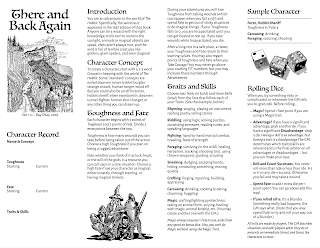

There and Back Again is a free two page game by Ray Otus based on my own blogpost "1937 Hobbit as Setting". As might be expected from a game of this size, it's quite rules light: the preview images on the Itch page give you the whole game. Even so, it provides a solid structure for handling a range of characters and genre play through a simple resolution system and GM adjudication. Admirably, there are many translations of this game, with Polish, French, German, Spanish, and two Italian translations. 

What I like about this game: Well, first, having a game based on a my own post is enormously flattering. But beyond that, I love how design in the OSR space is often translatory. That is, one writer creates an idea, two authors iterate on it, a fourth author unifies the disparate iterations, etc. I find that fascinating. My post was a response to another blog post, and Ray Otus carries the torch even further than I did. Wonderful.

Pipedream by Role Over Play Dead

Pipedream is a hack of Cthulhu Dark about halfling detectives - members of the "Lodge of Wisefellows" - who experiment with magical pipeweed to solve mysteries around their idyllic-but-mysterious home of Irisfields. 

Translating the paradigm of "humans vs unknowable, undefeatable evils" to "halflings vs everything else" is super, super smart. For example, halflings automatically are defeated in any physical challenge by...well, everything. If your Wisefellow needs to challenge someone bigger, they need to rely on trickery, smart planning, or *magic*. 

The setting of Irisfields is really evocative. It has that right "Tolkienesque" feeling - meaningfully different from the source material but tonally reminiscent. The setting is packed full of interesting details - things like highland goblins, spring elves, siege goats, and murder oaks.

What I like about this game: There are two magic systems in Pipedream: words of power and elder weed. Using magic can raise your Dream score. The higher your Dream score, the more potent your magic tends to be. However, if it ever reaches 6, you lose yourself completely to the Dream and your character retires a burnout. This is a really clever, really elegant way to handle magic in a Tolkien-ish setting. 

Against the Darkmaster by Open Ended Games
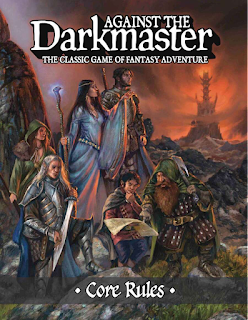

Against the Darkmaster is a retroclone of MERP. As I said in my review of the licensed Tolkien games, I have a lot of nostalgic fondness for MERP (though the game itself gives me a headache). 

Like other modern retroclones, Against the Darkmaster brings modern layout, thoughtful cross-referencing, and pleasing visual design to a classic game. The game is obviously made by fans for fans, and I love that. You will note that the cover is a direct visual nod to MERP's first edition cover. 

If you want to utilize MERP's backlog of 100s of modules but avoid the headache-inducing pages of cramped text, Against the Darkmaster is a great choice that requires minimum rules fiddling on your part.

What I like about this game: First, the game comes with its own soundtrack and I love it when games have soundtracks. Second, I really like the way the game separates race ("kins") and culture. It is easy to differentiate your wood elves and deep elves because they both are "elves" but one uses the Woodland culture and one uses the Underground culture. This is a nice way to make a generic-but-evocative game that can model the genre tropes you want.

Beyond the Wall by Flatland Games
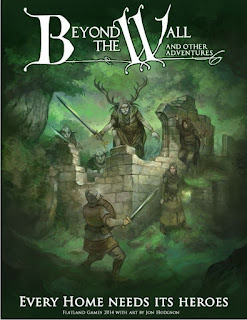

Beyond the Wall is an OSR game "inspired Ursula K. LeGuin, Susan Cooper, and Lloyd Alexander." Thus it is not really fair to say that this is just a Tolkien game with the serial numbers filed off. But there is a feeling of folklore and old world mythology embedded into this game that I can't help but feel is familiar of The Hobbit (if not the subsequent trilogy).

Beyond the Wall is my favorite OSR game and my go-to response whenever someone wants to branch out and try a new game. It combines the simplicity of the OSR ethos - rulings over rules, avoiding character "builds," open-ended challenge-based play - with a unified game design and modern resolution system. 

What I like about this game: Beyond the Wall is designed with adults in mind. It understands that players have kids, families, work responsibilities, and lives. The time you have to get together and play is short and sweet. It facilitates play by making character and scenario creation a minigame. As the players discover their characters through evocative playbooks ("Reformed Bully," "Witch's Prentice," "Would-Be Knight"), they are also generating relationships between each other ("The person on my right rescued me from the barrow wight when I uncovered the spellbook in the ancient tomb") and filling out their home village ("The blacksmith taught me everything he knew"). At the same time, the GM is filling out their scenario workbook to create the adventure that the players are going to run through that night. It's the perfect game for one shots and has several excellent (and inexpensive!) supplements about building out the game for campaign play. 

The Hero’s Journey by James M. Spahn


The Hero's Journey is an OSR game that utilizes the White Box rule set. The first edition is - by the author's admission - an attempt to create the "perfect" Tolkien game. The second edition advances this paradigm a little, wherein James M Spahn allows himself the freedom to wander farther afield from the source material.

Note: Several of the games in this list use Jon Hodgson art to good effect. He seems the go-to RPG illustrator if you want to invoke a Tolkienesque aesthetic.

What I like about this game: The book is full of little references for a Tolkien fan. Everything from the original publisher ("Barrel Rider Games") to spell names ("Breathed in Silver" - an illusion spell that references the C.S. Lewis quote that myths were "lies breathed through silver"). If you're a Tolkien enthusiast, these little gems contribute aesthetically to the overall tone of the text. 

Wayfarer’s Song by Christopher Johnstone


Wayfarer's Song is a free RPG heavily inspired by Norse mythology. Because The Lord of the Rings is also heavily inspired by Norse mythology, I've included it on this list. 

Like the WoD games or Burning Wheel, the game is split up between different character types - Men, Aelfan, Duegar, and Ettin - with the basic expectation that campaigns will focus on groups of one particular type.

As an indie game from the early 2000s, it definitely feels like a trad game of its time. But no matter your preferences for rules, there's so much creativity here that you will undeniably be inspired. Wayfarer's Song just oozes aesthetic. The linguistic choices are beautiful. You can be an elf from the Throne of Willows-Writhen. You can be a valraven warrioress. You can forge magical items with the bindrune of alarum. 

What I like about this game: In a lot of licensed games, you never get to have the stuff that the main characters from the inspiring media have. For instance, you won't get the Phial of Galadriel because that item is unique. But Wayfarer's Song gives you rules for creating light-filled phials. And that rules! 

Midnight by Fantasy Flight


Midnight is a game published under the 3.0 OGL. There were probably one million of these d20 games in the early 2000s and this one is my favorite.

The backstory of the game is this: The Dark Lord (Sauron Izrador) has tried to conquer the world several times and has always been thwarted...except this last time. The fellowship of heroes that rose against him was betrayed. The Shadow now stretches across the entire world: the Fourth Age has begun. 

A campaign setting with the premise of "Sauron wins actually lol" is great. Most d20 games feel shoehorned into the system, but somehow it works here. As a d20 game, it does have to bend over backwards to make the setting "low magic." It does this by moving using magic into a feat tree, with the Channeler base class getting the first magic feats for free, with real casting classes being locked into prestige classes taught by hidden forces that oppose the Dark Lord in secret enclaves. 

What I like about this game: The game includes "Heroic Paths" which grant additional feats. This additional power is meant to balance out the danger and the lack of magic (no clerics, healing potions, resurrection, etc.) in the setting. This lets you have incredible luck like Mat Cauthon or animal powers like Jon Snow in a way outside of your character class in a way that is very compelling.

Out of the Ashes by Paul Mitchener


Out of the Ashes is a game that ran a successful Kickstarter campaign in 2021 but has not yet been fulfilled. A playtest document was provided to backers, which is why I'm talking about it now.

The premise is similar-but-different to Midnight: the age has ended after a titanic war with the Dark Lord. The characters must come to terms with the old world passing away and rebuild their communities in a broken world. The game asks "What is Aragorn's post War of the Ring tax policy?" and means it in good faith. Very charming.

In the playtest document, the alternate name "After the Final War" is provided. I'm mildly disappointed that this wasn't the final game name since it feels less generic to me. Ah well. 

What I like about this game: Honestly any game that includes the option to play a not!elf who can do wire-fu and run across the tops of spears has me hook, line, and sinker. 

Back Again from a Broken Land by Cloven Pine Games


Back Again from a Broken Land is a PbtA game about characters returning home after the final war against evil - essentially playing out the Scouring of the Shire chapters. Like Out of the Ashes, it ran a successful Kickstarter campaign and is currently in pre-order for non-backers. I have ordered it but not read it, so I cannot speak more on this game except to say that I am excited to see it.

Under Hill, By Water by Me 


Under Hill, By Water is a game about halflings who don't want no adventures, thank you. It is obviously and earnestly an homage to the anachronistic little British nobility that live in a corner of Middle-earth, and an effort to create a cozy, slice of life game experience that you can pick up and play in off-weeks of your main game. Its supplement, Walking Holiday, is a long form essay on what makes travel in RPGs interesting and provides procedures for having interesting journey.

Conclusion

If you are trying to run a game that captures a Tolkienian aesthetic, I hope this post was somewhat helpful in finding the right game(s) for you. Please let me know how it goes! 

If there is another game that fits the bill that I have not included, please do leave a comment. I would love to read it.

Saturday, March 26, 2022

My Interview with Tony @ PlusOneExp

Tony Vasinda was kind enough to invite me on his RPG show PlusOneExp. I had a very fun time talking to him about:

  • Making travel fun
  • Alchemical subsystems
  • Dungeon Meshi
  • What IS the GLoG?
  • Enriching PDFs with digital tools
  • The current state of HIS MAJESTY THE WORM

Plus, I made this very handsome face. 

(Click The Handsome Face to hear our conversion.)

If you missed the live stream, click above to hear our conversation and check out the other cool work he's doing on his channel.

Tony is currently hosting a game jam on Itch called TogetherWeGo. There are some excellent designers participating and you should definitely check it out. 

Monday, March 21, 2022

Hexcrawl Dashboards

[Voiceover] You're just a GM who wants to run a hexcrawl! But has THIS happened to YOU?!

...You have the module open!

...And the map!

...And the random encounter tables!

...And a virtual dice roller!

...And the monster manual!

...And your notes!

Soon, there's so many windows open that you don't know which is which! There's GOT to be a BETTER WAY!


Introducing! The...

Hexcrawl Dashboard

I've put together a proof of concept for something I've been calling the Hexcrawl Dashboard: a patchwork of iFramed tools cobbled together onto a single site for ease of GM access. The gimmick is that you have a single page for your map, your encounters, your random encounters, your dungeons, your monster's stats - anything you need to reference during play.

Click the image to check out the sample Hexcrawl Dashboard

For this example, I have created a map of the Trollshaws of Middle-earth. There are forty keyed hex sites. Some sites have links to One-Page Dungeons. There are hundreds of random encounters. 

This site is written in a system neutral format. 

The content is borrowed from many sources (see below) but has been curated by yours truly to provide that *chef's kiss* Tolkien experience. 

For my machine's resolution, the site is best viewed at like 200%. If I was a better designer or wanted to spend more time on this, I could probably tweak it - but I'd argue that speed and efficiency are more important to a GM prepping a campaign and this is pretty easy to set up.

How did you make this?

This sample site is made up of a few different tools:

  • The website is just a simple Google Site. Everything is just iFramed into it.
  • The hexmap image was stolen  borrowed from a MERP book. I overlaid a basic hex pattern over it and added the numbers manually in an image editing program. 
  • I used interacty.me to place clickable hex descriptions onto each hex. 
    • Note: Interacty is free for people who list their purpose as educational but otherwise requires a fee. 
    • Note: Interacty limits the number of clickable icons to 40 per image. 
  • I used perchance.org to create a nested overloaded encounter table. I talk about my process for making a random table here (including the robust sources I drew from). 
    • Each time an encounter is rolled, it is marked off of the list. Your generator won't give you that result again until you refresh the page.
  • The content of the hex map is mostly borrowed from old MERP modules, hammered and chiseled to fit my own personal predilections.
  • The images for the hex map are either from Evind Earl's paintings for Disney films or from the background art of The Banner Saga (which was obviously inspired by him). The goal here is to evoke a particular tone for the GM while running the game.
  • Several hexes include content from entries to the One Page Dungeon contest.

What else is there?

There have already been some very good work in this space. For my money, everything Numbered Works does is prettier and shinier than this. But I slapped this together with a sort of simple speed that appeals to me. I would use my methodology if I was running a game for myself instead of publishing it.

If there are other no-code/low-code tools I should be aware of, please do put them in the comments!

Reflections

Basically, this sort of prep is indicative of what I would do the next time I wanted to run a hexcrawl or dungeon game. I don't want to flip around between all of my wonderful books - my old modules, my new modules, my friend's random tables, my own notes. I would just cobble them together into a few tools and then slap them in a website. 

Now that I've figured out what tools I want to use and how to employ them, I think this sort of prep would take ~an afternoon-ish of work to do, once the basic content has been generated/curated/selected. 

I am hopeful this level of up-front work will minimize the work I need to do at the table in the future. 

Wednesday, March 9, 2022

Random Encounters in the Trollshaws

I'm a big fan of random tables. Assuming I curate the table correctly, a random table brings a feeling of exciting realness to the flow of a game - they ensure I'm not just writing a fantasy novel in front of my players.

However, during a game, I can only have so many *things* in front of me. I'm always thinking, "Wait, I know I have a d100 list of books around here, where did I put the Dungeon Alphabet?" In practice, I've become frustrated with how many good tables I know I own vs how many good tables I can bring to hand easily.

I'm trying to solve this problem with technology. I started experimenting with Perchance.

Here is a generator I made to run a Middle-earth game set in the Trollshaws:


If you're looking for a random encounter table to use for your next MERP game, voila! You can stop here. 

If you're curious about the individual entries (there are hundreds), you can check out the generator on Perchance and click "edit." They are mostly stolen from d4caltrops and glassbirdgames, but curated to ensure a pure Tolkienian aesthetic.

If you're interested in the "theory" of my random encounter designs, read on!

Making random encounters

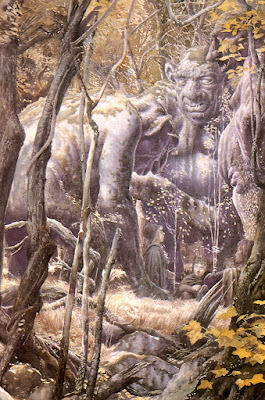
Art by Alan Lee

I talked in In Search of Better Travel Rules how random encounters that are just "Everyone makes a Travel check to navigate the marshes or takes 1d6 HP damage" are boring. No matter what the flavor is, rolling dice and taking an HP tax is not an interesting encounter. Random encounters need choice to be interesting.

In Walking Holiday, I laid out the basic procedure that I use: wandering encounters are combined with static, landmark encounters to create the scene the players find when they travel to a new location. Wandering encounters are basically Necropraxis's Overloaded Encounter Die. (Schwew, that's a lot of references.) 

Consider the troll scene in The Hobbit. This is actually a super gameable scene. The trolls all have names - they're not just Troll 1, Troll 2, and Troll 3. They are a strong enemy that has treasure, but must be fought or dealt with through stealth. They can be negotiated with somewhat - they even argue about whether to let Bilbo go at first. They have an obvious weakness to be exploited. 

Would that every encounter on a random table was so rich with possibility.

For the wandering encounters in this generator, there are four possible types: 

  1. Curiosity: These are basically "nothing happens," but framed to give context and flavor to the environment.
  2. Sign: These are hints at hazards or monsters that live in this area. Because there are only about a dozen of these, these programmatically happen only about half as frequently as other encounter types.
  3. Travel Event: These are scenes that provide open-ended problems to avoid a hazard or gain some reward. There are about twenty of these.
  4. Encounters: These are scenes with friendly or unfriendly NPCs. There are hundreds of these.

Each time an encounter is rolled, it is marked off of the list. Your generator won't give you that result again until you refresh the page.

For Encounters, it's vital that these are never framed as "1d4 red dragons." Some random tables try to randomly provide activities for the monsters and this can sometimes produce weird results like "3 skeletons are dancing." Luckily, d4caltrops provides lots of inspiration here as they have d100 monster activities for each creature in the Monster Manual (including interesting variations on only barely different monsters - such as pirates vs buccaneers). 

Encounters should be a mix of both friendly and non-friendly NPCs. Moreover, almost no entry is "1d4 starving wolves attack." Almost everything can be talked to, almost everything can be handled outside of combat. 

The generator is doing a lot of work here. Each monster is assigned a type (hill troll vs stone troll), an appropriate number, and an activity based on the time of day. Friendly NPCs are given names. Trolls occur frequently (it's a region called the Trollshaws after all) but only occur at night.

This generator was made as an experiment. If I was going to spend more time on it, I'd probably bake a weather hex flower into it and give the unfriendly NPCs names as well.

Anyway, I hope there's something worthwhile here for you!


Saturday, March 5, 2022

Cut-Out Decoration Cards for your Cozy Hole Home

I have made a toy.

The equipment cards from Mausritter/Last Gasp Grimoire are so fun. The gimmick is that you print out your equipment cards on card stock and use blue tack to stick them physically onto your character sheet, so you have a sort of Diablo pack experience.

I took this paradigm and applied it to decorations for the cozy hole that you call a home. All artwork is stolen from Mike Ploog's background art in Ralph Bakshi's Fellowship of the Ring.

Choose a decoration for your tiny home.

Place them in your parlor...

...or in your entrance hall.

Click on any of the pictures above - or click here - to download all of the assets. 

Use this for your Mausritter games or maybe even Under Hill, By Water.

Friday, February 11, 2022

Walking Holiday, a supplement for Under Hill, By Water, now live

I have just released Walking Holiday. 

Walking Holiday is an Under Hill, By Water supplement that contains procedures for traveling from one place to another, as well as some advice on how to make these procedures actually fun. 

The GM will take an afternoon to do some prep. First, the GM will randomly generate and draw a map to represent what lies outside of your home village. Second, they’ll write down interesting things to find there (but no adventures, certainly!)

Afterwards, players can go on walking holidays to see a bit of the lay of the land between halfling villages. This journey is the game.

Click to get the game!

In Search of Better Travel Rules

Journeys and travels are a fantasy staple. As such, RPG players have long tried to include this essential element in their games only to find the experiences fall flat. Often, travel is either reduced to a skill check or handwaved entirely. I raved about this in my post In Search of Better Travel Rules. 

First, complain. Identify the problem. Then, do something about it.

Walking Holiday is a game supplement that makes traveling fun by infusing interesting choices into the journey. The game includes:
  • Procedures for pointcrawling 
  • Map making by dropping dice and drawing landmarks
  • Collaborative rumor generation about the map's contents
  • Dozens of example encounters and strange landmarks 
  • An optimized PDF with links and bookmarks, as well as layers that can be turned off for printing purposes

Here’s an example of what I mean:
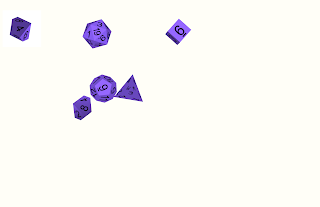
You can generate a map for your players by picking up one of every type of platonic dice - a d4, d6, d8, d10, d12, and a d20. Toss ‘em on some paper. 
Normal stuff is lower numbers so they're more likely to occur.

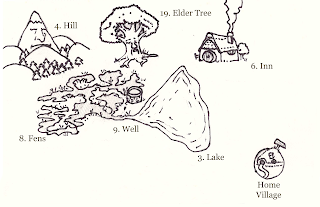
Then, you reference what landmarks you’ve rolled and draw them in. 

(Drawing can be fun even if you’re not good at it - like me!)


Have a nice trip!

Because Walking Holiday is designed for use with Under Hill, By Water, the example encounters and NPCs are intended to provide a cozy, slice-of-life experience.

Even so, the procedures, advice, and game theory included are universally applicable. Use Walking Holiday to improve your journeys for any game where travel is featured.

Walking Holiday Yuletide Jam

I have been so thrilled and so touched by the community’s involvement in my little game’s little jam. I wanted to highlight the entries because I believe they enrich the experiences for everyone who plays Under Hill, By Water by adding new NPCs, systems, creatures, etc. 

A Collection of Things That Most Certainly Are Not
By Wayspell
A bestiary written in-character by the adventurous (feh) halfling Unreliable Wanderfoot. It is a hand-drawn supplement that provides pictures and stats for a variety of creatures beyond the Hedge.

Auntie Everline
By Evlyn Moreau

A spider NPC that serves as a wonderfully monstrous neighbor to the PCs. Living just over the Hedge, she provides  the PCs aid in a cool way: you help her out with tasks so the GM can noodle on answers to the questions you’ve asked her. 

Of Mushrooms Meet and & Marvelous
By Kris Goldsmith

This scenario (not adventure, certainly) provides the PCs the opportunity to enter the yearly Harvest Faire. To win the top prize, the players have to find a way to get the best mushrooms in the Vale out of the fields of mean ol’ Farmer Worm. 

If you’re looking for a great introduction to the game to run for a night where you don’t have your normal game night, this is a great choice.

How Hard Can It Be?
By Seedling Games
This supplement introduces a crafting mechanic to the game that is infinitely expandable. The basic mechanic cleverly balances misfortune against progress. If you’re running Under Hill, By Water a lot and want to measure the PCs’ long-term progress for their tasks around their village, this is a smart way to do it.

Heart and Hillside Home
By Into the Wild Blue Yonder
Additional randomizers to infuse your village with color and texture. This includes lists of fancy food (you prefer 11 meals a day, if you can get them), rumors of things outside the Hedge, and more! 


These supplements are so cool and well worth your time and $$$. I hope you’ll check them out! 

The road goes ever on and on…


Wednesday, February 9, 2022

Scars

The following rules were drafted and playtested for the forthcoming game HIS MAJESTY THE WORM, currently Itchfunding. I ultimately cut them from the main text. Both I and my players enjoyed them but they did not feel like they were explicitly furthering the goals of the game. Sometimes you have to drown your darlings.

Anyway, here they are in case they’re interesting to you for your games. 

Scars

“Though he had been healed in Rivendell of the knife-stroke, that grim wound had not been without effect. His senses were sharper and more aware of things that could not be seen. One sign of change that he soon had noticed was that he could see more in the dark than any of his companions, save perhaps Gandalf.” - Fellowship of the Ring, J.R.R. Tolkien

 My family has a legend about my great grandmother. It was said that she was so fed up with getting seasonal poison ivy and suffering those itchy welts that she finally ate a poison ivy leaf sandwich. It sent her to the hospital.

But she survived. And she never got poison ivy again.

Believe my family legend or not, it’s the basis of this subsystem. So strap in:

  • You were dead. Now you’re not. You bear a mark from your death.

  • Describe your scar. Every time you see it, it reminds you of the time you died.

  • Based on the enemy that marked you in this way, you gain a new talent. This talent may be Wounded like any other.

  • You may only gain a scar once per Crawl.

The list of scar talents below is not exhaustive. Work out the specifics of your scar with your GM.

 Animate Statue Scar

A hand-shaped scar. In the brief moment of your death, the statue’s machinations made sense to you. Spend a lore bid and ask the GM where the animated statue’s empowering rune is.

Bloodybones Scar

The bloodybone skeletons stripped all the flesh off of one of your hands, trying to free their “lost brother” under your skin. Luckily, your skeletal hand still functions more or less as normal. One of your skeletal fingers is a “skeleton key.” It functions as a lockpick that you always have on you.

Bog Zombie Scar

An ugly wound, swollen and pus-filled. It never quite heals. As long as this talent is not Wounded, undead will ignore you. You are invisible to them. They smell themselves on you.

Brain Spider Scar

The thing left scars you couldn’t see, deep in your head. As long as you are in physical contact with someone, you can communicate with them telepathically. This freaks most people out, but allows you to overcome a language barrier.

Cockatrice Scar

One of your eyes remains stone, smooth and polished like marble. You can pop it out and still see through it. Also, it is made out of stone, so it’s really hard to hurt.

Devil Scar

A red blotch that looks vaguely like writing. You become extremely good at legalese. You can spend a lore bid to ask the GM if there are any hidden clauses in a contract that you should know about. The GM will lay everything out clearly.

Your scar prickles whenever you enter a mythraeum (aka temple).

Face Rat Scar

The rat stole your fucking face. Now there’s just a big blank fleshy space between your hairline and your chin. You can still eat with that little slit and see basically okay, but you have no face. If you ever find another face rat, you can cut their face off and wear it like a mask. It fuses onto your blankness and is a perfect disguise. The more face rats you catch, the more disguises you gain.

Fungoid Scar

Your scar sprouts ugly little brown mushrooms. If you ever actually die, these will sprout into a fungoid doppleganger. Nobody will be able to tell the difference (at least at first).

Griffin Scar

The humans of House Gryphes host griffin hunts in honor of their king. Scars from griffins earn you mad respect with that group. Any member of the ruling house of the City will listen to tales of how you got your scar with rapturous attention.

Harpy Scar

A smear of white scar tissue reminiscent of pigeon shit on your car. You become great at insulting someone. During a Challenge, you may treat Banter as either a Cups or Wands action.

Imp Scar

An ugly scar that looks like a grinning mouth. You can spend 2 Resolve to retry a test of fate that became a great failure.

 Jinn Scar

You were burned by the jinn. When the burned healed, it was in a hauntingly beautiful pattern of rainbow hues. Undeniably a burn, but somehow beautiful. This scar notably benefits sorcerers. While this talent is unWounded, you may use your magic whenever someone else holds an appropriate component and wishes you to.

If someone in your vicinity is holding a component, you may cast the spell “for” them.

  • During a Challenge, the person making the wish must use the Speak Incantations action.

    • You must know the appropriate talent to cast that particular component’s spell.

  • Either you or the person making the wish may spend the Resolve.

  • If neither of you are willing, nothing happens.

  • You must still be able to see or touch your target, per normal.

  • You can only concentrate on one spell at a time, per normal.

Kelpie Scar

You can cast the spell Defy Depths (see Appendix X, page XX) on yourself for a Resolve without a component. This spell requires concentration as normal.

Lion Scar

The outline of the lion’s bite shines with raw, pink flesh. Anyone marked by a lion carries the power of the king of beasts. You gain favor in tests of fate to tame or calm wild animals. 

Mimic Scar

Once bitten, twice shy. You may spend a lore bid to ask a GM if any one item is actually a mimic. They’ll answer honestly. 

Nymph Scar

Any scar suffered from a nymph’s meddling always turns out super dramatic. You look like a badass. You can spend a Resolve to ignore a nymph’s charm power and all other Inspire Trust or Inspire Joy effects. 

Ogre Scar

The scar barfs forth a teratoma. You grow a proto head. Everybody thinks it’s gross and people generally default to the distaste disposition when they see you. However, as long as it’s uncovered, your scar will bark out a warning if you are ever ambushed. You are never surprised. 

Questing Beast Scar

A bite mark. You can spend a Resolve to ask the GM in which direction lies your personal quest (but not a guild-fellow's quest). They will answer you honestly.

When this talent is Wounded, the scar begins to whine and yip like a pack of dogs and stealth becomes impossible. 

Slime Scar

The slime devoured one of your limbs (talk with the GM about which one makes the most sense). However, it left a little bit of itself behind. You grow a new limb out of slime. It behaves more or less like a normal limb, except it’s obviously an oozeand is super hard to actually hurt. It can be hit by a nine-pound hammer, slammed inside an iron maiden, or stretched on the rack and suffer no lasting harm. Fire still hurts it, though.

Titan Scar

Scarification of your lungs leaves you with a permanent rasp and the ability to belch out a cloud of elemental spume. For 2 Resolve, you can exhale a cloud of elemental energy appropriate to the titan who scarred you. This cloud affects everybody in the zone except for you.

During combat, using this ability is a Wands action that targets the initiative of everybody in the zone.

  • A breath of fire lights all untended flammable objects aflame. Everybody affected in the zone catches fire. They take a Wound at the beginning of their focus action unless they use a Recover action to put themselves out.

  •  A breath of ice freezes all potions, oils, or bombs (making them unusable until warmed up). Everybody affected is crystalized and Rooted and Stunned until they make a Recover action to free themselves.

Ungoat Scar

A honeycomb of flesh that elicits a severe trypophobia response. You’re not sure it’s ever going to heal. If you would ever prompt maleficence as a sorcerer, you can draw twice and choose the result using the tables in Appendix III, page XX.

Vampire Scar

A vampiric scar—often intense scarification of the neck—carries a connection to the undead. By spending a lore bid, you can detect the presence of a vampire. If one is present on the same level of the Underworld, the GM will tell you which path is closest to it. If one is present in the same room (hidden, in one of a thousand coffins, etc.), the GM will tell you exactly where it is.

Unfortunately, this connection goes both ways. All vampires can sense you in the same way. You are a beacon in the night to their eyes.

Winter Wolf Scar

The wound festers into a cluster of crystals, icy cold to the touch. Anything you touch it to becomes frozen after five or ten minutes of close contact. 

Wraith Scar

Your scar is always cold to the touch. You now live half in the wraith world and half in the world of the living. You can interact with and attack wraiths, shadows, specters, and other spiritual enemies, even with your bare hands or mundane weapons. 

Yellow King Scar

A horrible creeping yellow blotch. You swear it gets bigger every time you look at it, as if it’s consuming you. By spending a Resolve, you can resist a spell cast on you. The caster’s Resolve is still spent.