Friday, June 10, 2022

Glamour-Weaver - Freeform Illusion Magic

If you want to play a gnome illusionist or a bard whose songs take shape or a hard-light construct who crash landed into your fantasy setting, you can use this class. 

Glamour-Weaver

Saves and Levels: As a thief

Proficiencies: As a magic-user

Runes: At level 1, gain three random runes. Every level thereafter, gain one random rune. 

With a week of downtime and 1,000 silver in magical materials (mithril inks, obsidian mirrors, lights reflected from distant stars), you may attempt to research a specific rune. At the end of the week, Save vs Wands. If successful, you learn the rune you were researching. If you fail, you do not learn the rune and your research is wasted.


Note: Runes map 1-to-1 with the English alphabet equivalent. Runes are just cooler than "letters."

Weave Glamour: A glamour is an illusion. An illusion is a hologram, false smell, or artificial sound. It is always additive, never subtractive. For example, you cannot turn yourself invisible using an illusion. You can create an illusion of a wall in front of you and hide behind it. An illusion "pops" when interacted with. 

You can create an illusion of any creature or thing that begins with the letter of a known rune. For example, if you know the "a" rune, you can conjure an illusion of an auroch, an axe, or an apple. 

You may have one illusion active at a time. There is no upper limit to the number of illusions you can create per day. 

You can describe the illusions you create with a number of words equal to your levels of glamour-weaver. Each word of your description must start with a rune letter that you know.

For example, if you know the "a" rune, "w" rune, and "o" rune, you could cast an illusion of a "Adamantine Wall" or a "Weird Ant" or "Acid Well" as a level 2 glamour-weaver. At level 3, you could conjure "Oily Adamantine Wall", "Weird Old Aunt" or "Acidic Orcish Warrior."

If you not specify a detail of your illusion, the Referee has the prerogative of describing what the illusion looks like. If you simply conjure a "Wall," the Referee can say if the wall is stone or wood, painted or unpainted, etc. 

Illusions will always look like normal objects unless otherwise specified by the glamour-weaver. If you conjure a "Wall," the Referee will never say that it is a wall of ice. 

Your illusions are stationary unless you specify that they take some action. For example, a "Patrolling Orc" will walk back and forth, as if on patrol. "Group of gossiping old women" will talk back and forth banally while knitting. 

Wednesday, June 1, 2022

15 (more) cheap tricks

One of my fave GLoG blogs - Whose Measure God Could Not Take - did a fun meme about listing cheap tricks that GMs can use to make their game better. You can see the original and the resulting links to other cheap tricks here.

Here are 15 more cheap tricks.

1. Give your players an INC map. Seriously. Choosing the routes gives players an interesting decision point and discovering the room contents is fun. Saying "Wait, you said TWO exits on the north wall? I gotta redraw" is less fun.

1a. You can still have secret rooms. Seeing the "gaps" on the map and finding the door will make players feel smart.

2. Unless you're learning the game for the first time, don't pause the game to look up rules. Make the call the players want you to make, then get a rules lawyer to look it up while you continue the flow of the game.

3. The key to a good riddle is "something the players know but one detail changed." Take a riddle from the Hobbit and change the wording around. Players'll feel smart.

4. Ditto with monsters. Take a normal monster and change one feature to make it seem interesting. A cowardly troll covered in unhealed burns. A cyclops that sees six seconds into the future. A skeleton but it has a wasp's nest in it.

5. Introduce members of the PC's family and resist the urge to kill them for dramatic effect. "I'm not mad, I'm just disappointed" produces a stronger emotional reaction than "Oh no your dad is dead."

6. Ask players to recap the session for you each time. a) This makes them actually take notes and pay attention. b) You can better understand the gap between your understanding and theirs.

7. When players help out with some of the tasks a GM normally does (like the recap, above) throw them a bennie. Giving them a free reroll or something is free.

8. "Please give me feedback" is too unspecific to be helpful. Take some time to ask for "highs and lows" between games. Each player says their favorite/least favorite part of the session/arc/campaign.

9. "What do you have in your hands?" is the most important question you can ask. How can they pick a lock if they have a torch in their hand? How can they pick a lock if they don't have light?

10. "How does your character feel about that?" is a great question to share the spotlight with someone who isn't directly involved in the action.

11. Describe what monsters look like, not what their name is. A goblin is much grosser when it's "a stinky little guy about the size of a 3 year old but with bat ears and it has most of what-was-once-a-rat in its fanged mouth"

12. Why do you not have a dragon in literally every dungeon you make? You fool. You simpleton.

13. Non-monetary rewards are cool. Give a PC a byname (e.g., "the Troll Slayer"). Give a PC a spouse (e.g., "The duke offers his daughter's hand). Tell the PC that the necromancer "owes you one."

14. When you make a ruling, explain your justification out loud. If you're targeting a random person, tell the players the stakes before you roll. "OK, evens the wyrm goes after Faust but on odds it'll go for Drena even though she's on the ground."

15. Asking "Describe how you finish it" when the player would drop a monster is great for 3 reasons. 1) Opportunity for the player to give a cool description 2) Opportunity to be non-lethal ("I tie it up!") 3) Evil GM trick: If the monster needs some special gimmick (e.g., stake to the heart, decapitation, fire) to kill it, it doesn't actually die unless the PC specifically says it


Sunday, May 8, 2022

Tolkien-Style Maps

Warren at I Cast Light said this and got my brain going this weekend:

"Related: I would love to see the OD&D Outdoor Survival map become more a defacto map that everyone iterates on. Outdoor Survival map provides that richer environment. Also easier to provide your own spin on a recipe when the base is worked out like a chocolate chip cookie recipe."

So I sat down and I made this version of the Outdoor Survival map for a Secret Project I am working on:

Click for full sized version.

If you're unfamiliar with the Outdoor Survival map, here's a quick history from a blogpost I wrote for the (now sadly defunct) OSR Elfgame website:

"The origins of Dungeons & Dragons (D&D) lie in medieval wargaming. When Gygax and Arneson were building out the earliest RPG paradigms, they used whatever they could get their hands on to represent their fantastic medieval dioramas. When it came time for their fighters and armies to move across the wild landscape, they reached for a board game that was already on their shelf: Outdoor Survival, published by Avalon Hill. The game was about orienteering hikers and featured (you guessed it) a hex map of a wild expanse. A copy of this board game was actually required to play original D&D (it’s listed as a requisite on page 5 of the “Men and Magic” book, alongside polyhedral dice and a “patient Referee”)."

I had never made a map in this style and am tentatively pleased with the initial results. Here is how I did it:

1. I started with Chris Taylor's scalable bitmap version of the Middle-earth map  (many thanks for this yeoman's work!)

2. I created Photoshop brushes and stamps using the assets

3. I used the original Outdoor Survival map as the base layer in Photoshop and set my drawing layer at a 75% opacity over it

4. I traced over the map with my brushes and stamps

I bundled the asset pack I used into this ZIP file, free to download. If you want to make your own Tolkien style map, you can use these as brushes and stamps to do so. 

If you make something using these assets, please show it to me! I'd love to see what you create!


Sunday, March 27, 2022

Non-licensed not!Tolkien games

A small story

When I was 12, I was introduced to RPGs. I said "Oh I will make one for Lord of the Rings." I went home and wrote it in a notebook. 

It was terrible. 

For the last 20 years, I have been chasing this white whale. Here is what I have learned:

There is no one, perfect game. There is only the perfect game for the campaign you want to run (some assembly required). 

If you want to run a Tolkien game, there are a lot of resources to help you assemble the right game for you, both licensed and unlicensed. 

What's this post about?

Given this story and this blog I suspect no one is surprised that I have Opinions (TM) about Lord of the Rings games. 

Here is a blog post about licensed Tolkien games. 

What follows is a blog post about games that feel "Tolkienesque" but are not licensed

This is different from a Tolkien RPG fan project (of which there are many). These are games that have scratched off the serial numbers. They beg the ever-more-litigious Tolkien Enterprises to not sue them.
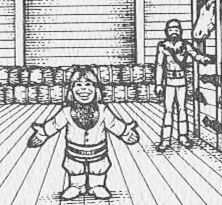
The unfortunately named "bobbit" from Ultima I, 1980

Here are some games that have a Tolkienique aesthetic to me:

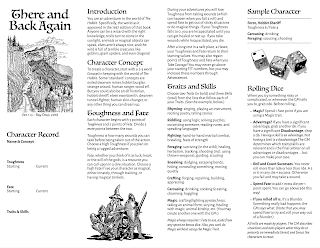
  • There and Back Again by Ray Otus
  • Pipedream by Role Over Play Dead
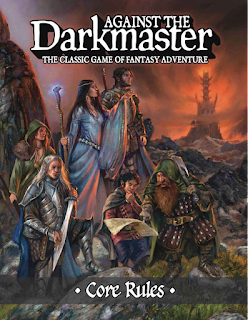
  • Against the Darkmaster by Open Ended Games
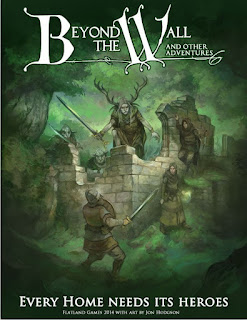
  • Beyond the Wall by Flatland Games
  • The Hero’s Journey by James M. Spahn
  • Wayfarer’s Song by Christopher Johnstone
  • Out of the Ashes by Paul Mitchener
  • Midnight by Fantasy Flight
  • Back Again from a Broken Land by Cloven Pine Games
  • Under Hill, By Water by me

I've written a summary of each of these below.

There and Back Again by Ray Otus


There and Back Again is a free two page game by Ray Otus based on my own blogpost "1937 Hobbit as Setting". As might be expected from a game of this size, it's quite rules light: the preview images on the Itch page give you the whole game. Even so, it provides a solid structure for handling a range of characters and genre play through a simple resolution system and GM adjudication. Admirably, there are many translations of this game, with Polish, French, German, Spanish, and two Italian translations. 

What I like about this game: Well, first, having a game based on a my own post is enormously flattering. But beyond that, I love how design in the OSR space is often translatory. That is, one writer creates an idea, two authors iterate on it, a fourth author unifies the disparate iterations, etc. I find that fascinating. My post was a response to another blog post, and Ray Otus carries the torch even further than I did. Wonderful.

Pipedream by Role Over Play Dead


Pipedream is a hack of Cthulhu Dark about halfling detectives - members of the "Lodge of Wisefellows" - who experiment with magical pipeweed to solve mysteries around their idyllic-but-mysterious home of Irisfields. 

Translating the paradigm of "humans vs unknowable, undefeatable evils" to "halflings vs everything else" is super, super smart. For example, halflings automatically are defeated in any physical challenge by...well, everything. If your Wisefellow needs to challenge someone bigger, they need to rely on trickery, smart planning, or *magic*. 

The setting of Irisfields is really evocative. It has that right "Tolkienesque" feeling - meaningfully different from the source material but tonally reminiscent. The setting is packed full of interesting details - things like highland goblins, spring elves, siege goats, and murder oaks.

What I like about this game: There are two magic systems in Pipedream: words of power and elder weed. Using magic can raise your Dream score. The higher your Dream score, the more potent your magic tends to be. However, if it ever reaches 6, you lose yourself completely to the Dream and your character retires a burnout. This is a really clever, really elegant way to handle magic in a Tolkien-ish setting. 

Against the Darkmaster by Open Ended Games


Against the Darkmaster is a retroclone of MERP. As I said in my review of the licensed Tolkien games, I have a lot of nostalgic fondness for MERP (though the game itself gives me a headache). 

Like other modern retroclones, Against the Darkmaster brings modern layout, thoughtful cross-referencing, and pleasing visual design to a classic game. The game is obviously made by fans for fans, and I love that. You will note that the cover is a direct visual nod to MERP's first edition cover. 

If you want to utilize MERP's backlog of 100s of modules but avoid the headache-inducing pages of cramped text, Against the Darkmaster is a great choice that requires minimum rules fiddling on your part.

What I like about this game: First, the game comes with its own soundtrack and I love it when games have soundtracks. Second, I really like the way the game separates race ("kins") and culture. It is easy to differentiate your wood elves and deep elves because they both are "elves" but one uses the Woodland culture and one uses the Underground culture. This is a nice way to make a generic-but-evocative game that can model the genre tropes you want.

Beyond the Wall by Flatland Games


Beyond the Wall is an OSR game "inspired Ursula K. LeGuin, Susan Cooper, and Lloyd Alexander." Thus it is not really fair to say that this is just a Tolkien game with the serial numbers filed off. But there is a feeling of folklore and old world mythology embedded into this game that I can't help but feel is familiar of The Hobbit (if not the subsequent trilogy).

Beyond the Wall is my favorite OSR game and my go-to response whenever someone wants to branch out and try a new game. It combines the simplicity of the OSR ethos - rulings over rules, avoiding character "builds," open-ended challenge-based play - with a unified game design and modern resolution system. 

What I like about this game: Beyond the Wall is designed with adults in mind. It understands that players have kids, families, work responsibilities, and lives. The time you have to get together and play is short and sweet. It facilitates play by making character and scenario creation a minigame. As the players discover their characters through evocative playbooks ("Reformed Bully," "Witch's Prentice," "Would-Be Knight"), they are also generating relationships between each other ("The person on my right rescued me from the barrow wight when I uncovered the spellbook in the ancient tomb") and filling out their home village ("The blacksmith taught me everything he knew"). At the same time, the GM is filling out their scenario workbook to create the adventure that the players are going to run through that night. It's the perfect game for one shots and has several excellent (and inexpensive!) supplements about building out the game for campaign play. 

The Hero’s Journey by James M. Spahn


The Hero's Journey is an OSR game that utilizes the White Box rule set. The first edition is - by the author's admission - an attempt to create the "perfect" Tolkien game. The second edition advances this paradigm a little, wherein James M Spahn allows himself the freedom to wander farther afield from the source material.

Note: Several of the games in this list use Jon Hodgson art to good effect. He seems the go-to RPG illustrator if you want to invoke a Tolkienesque aesthetic.

What I like about this game: The book is full of little references for a Tolkien fan. Everything from the original publisher ("Barrel Rider Games") to spell names ("Breathed in Silver" - an illusion spell that references the C.S. Lewis quote that myths were "lies breathed through silver"). If you're a Tolkien enthusiast, these little gems contribute aesthetically to the overall tone of the text. 

Wayfarer’s Song by Christopher Johnstone


Wayfarer's Song is a free RPG heavily inspired by Norse mythology. Because The Lord of the Rings is also heavily inspired by Norse mythology, I've included it on this list. 

Like the WoD games or Burning Wheel, the game is split up between different character types - Men, Aelfan, Duegar, and Ettin - with the basic expectation that campaigns will focus on groups of one particular type.

As an indie game from the early 2000s, it definitely feels like a trad game of its time. But no matter your preferences for rules, there's so much creativity here that you will undeniably be inspired. Wayfarer's Song just oozes aesthetic. The linguistic choices are beautiful. You can be an elf from the Throne of Willows-Writhen. You can be a valraven warrioress. You can forge magical items with the bindrune of alarum. 

What I like about this game: In a lot of licensed games, you never get to have the stuff that the main characters from the inspiring media have. For instance, you won't get the Phial of Galadriel because that item is unique. But Wayfarer's Song gives you rules for creating light-filled phials. And that rules! 

Midnight by Fantasy Flight


Midnight is a game published under the 3.0 OGL. There were probably one million of these d20 games in the early 2000s and this one is my favorite.

The backstory of the game is this: The Dark Lord (Sauron Izrador) has tried to conquer the world several times and has always been thwarted...except this last time. The fellowship of heroes that rose against him was betrayed. The Shadow now stretches across the entire world: the Fourth Age has begun. 

A campaign setting with the premise of "Sauron wins actually lol" is great. Most d20 games feel shoehorned into the system, but somehow it works here. As a d20 game, it does have to bend over backwards to make the setting "low magic." It does this by moving using magic into a feat tree, with the Channeler base class getting the first magic feats for free, with real casting classes being locked into prestige classes taught by hidden forces that oppose the Dark Lord in secret enclaves. 

What I like about this game: The game includes "Heroic Paths" which grant additional feats. This additional power is meant to balance out the danger and the lack of magic (no clerics, healing potions, resurrection, etc.) in the setting. This lets you have incredible luck like Mat Cauthon or animal powers like Jon Snow in a way outside of your character class in a way that is very compelling.

Out of the Ashes by Paul Mitchener


Out of the Ashes is a game that ran a successful Kickstarter campaign in 2021 but has not yet been fulfilled. A playtest document was provided to backers, which is why I'm talking about it now.

The premise is similar-but-different to Midnight: the age has ended after a titanic war with the Dark Lord. The characters must come to terms with the old world passing away and rebuild their communities in a broken world. The game asks "What is Aragorn's post War of the Ring tax policy?" and means it in good faith. Very charming.

In the playtest document, the alternate name "After the Final War" is provided. I'm mildly disappointed that this wasn't the final game name since it feels less generic to me. Ah well. 

What I like about this game: Honestly any game that includes the option to play a not!elf who can do wire-fu and run across the tops of spears has me hook, line, and sinker. 

Back Again from a Broken Land by Cloven Pine Games


Back Again from a Broken Land is a PbtA game about characters returning home after the final war against evil - essentially playing out the Scouring of the Shire chapters. Like Out of the Ashes, it ran a successful Kickstarter campaign and is currently in pre-order for non-backers. I have ordered it but not read it, so I cannot speak more on this game except to say that I am excited to see it.

Under Hill, By Water by Me 


Under Hill, By Water is a game about halflings who don't want no adventures, thank you. It is obviously and earnestly an homage to the anachronistic little British nobility that live in a corner of Middle-earth, and an effort to create a cozy, slice of life game experience that you can pick up and play in off-weeks of your main game. Its supplement, Walking Holiday, is a long form essay on what makes travel in RPGs interesting and provides procedures for having interesting journey.

Conclusion

If you are trying to run a game that captures a Tolkienian aesthetic, I hope this post was somewhat helpful in finding the right game(s) for you. Please let me know how it goes! 

If there is another game that fits the bill that I have not included, please do leave a comment. I would love to read it.

Saturday, March 26, 2022

My Interview with Tony @ PlusOneExp

Tony Vasinda was kind enough to invite me on his RPG show PlusOneExp. I had a very fun time talking to him about:

  • Making travel fun
  • Alchemical subsystems
  • Dungeon Meshi
  • What IS the GLoG?
  • Enriching PDFs with digital tools
  • The current state of HIS MAJESTY THE WORM

Plus, I made this very handsome face. 

(Click The Handsome Face to hear our conversion.)

If you missed the live stream, click above to hear our conversation and check out the other cool work he's doing on his channel.

Tony is currently hosting a game jam on Itch called TogetherWeGo. There are some excellent designers participating and you should definitely check it out. 

Monday, March 21, 2022

Hexcrawl Dashboards

[Voiceover] You're just a GM who wants to run a hexcrawl! But has THIS happened to YOU?!

...You have the module open!

...And the map!

...And the random encounter tables!

...And a virtual dice roller!

...And the monster manual!

...And your notes!

Soon, there's so many windows open that you don't know which is which! There's GOT to be a BETTER WAY!


Introducing! The...

Hexcrawl Dashboard

I've put together a proof of concept for something I've been calling the Hexcrawl Dashboard: a patchwork of iFramed tools cobbled together onto a single site for ease of GM access. The gimmick is that you have a single page for your map, your encounters, your random encounters, your dungeons, your monster's stats - anything you need to reference during play.

Click the image to check out the sample Hexcrawl Dashboard

For this example, I have created a map of the Trollshaws of Middle-earth. There are forty keyed hex sites. Some sites have links to One-Page Dungeons. There are hundreds of random encounters

This site is written in a system neutral format. 

The content is borrowed from many sources (see below) but has been curated by yours truly to provide that *chef's kiss* Tolkien experience. 

For my machine's resolution, the site is best viewed at like 200%. If I was a better designer or wanted to spend more time on this, I could probably tweak it - but I'd argue that speed and efficiency are more important to a GM prepping a campaign and this is pretty easy to set up.

How did you make this?

This sample site is made up of a few different tools:

  • The website is just a simple Google Site. Everything is just iFramed into it.
  • The hexmap image was stolen  borrowed from a MERP book. I overlaid a basic hex pattern over it and added the numbers manually in an image editing program. 
  • I used interacty.me to place clickable hex descriptions onto each hex. 
    • Note: Interacty is free for people who list their purpose as educational but otherwise requires a fee. 
    • Note: Interacty limits the number of clickable icons to 40 per image. 
  • I used perchance.org to create a nested overloaded encounter table. I talk about my process for making a random table here (including the robust sources I drew from). 
    • Each time an encounter is rolled, it is marked off of the list. Your generator won't give you that result again until you refresh the page.
  • The content of the hex map is mostly borrowed from old MERP modules, hammered and chiseled to fit my own personal predilections.
  • The images for the hex map are either from Evind Earl's paintings for Disney films or from the background art of The Banner Saga (which was obviously inspired by him). The goal here is to evoke a particular tone for the GM while running the game.
  • Several hexes include content from entries to the One Page Dungeon contest.

What else is there?

There have already been some very good work in this space. For my money, everything Numbered Works does is prettier and shinier than this. But I slapped this together with a sort of simple speed that appeals to me. I would use my methodology if I was running a game for myself instead of publishing it.

If there are other no-code/low-code tools I should be aware of, please do put them in the comments!

Reflections

Basically, this sort of prep is indicative of what I would do the next time I wanted to run a hexcrawl or dungeon game. I don't want to flip around between all of my wonderful books - my old modules, my new modules, my friend's random tables, my own notes. I would just cobble them together into a few tools and then slap them in a website. 

Now that I've figured out what tools I want to use and how to employ them, I think this sort of prep would take ~an afternoon-ish of work to do, once the basic content has been generated/curated/selected. 

I am hopeful this level of up-front work will minimize the work I need to do at the table in the future. 

Wednesday, March 9, 2022

Random Encounters in the Trollshaws

I'm a big fan of random tables. Assuming I curate the table correctly, a random table brings a feeling of exciting realness to the flow of a game - they ensure I'm not just writing a fantasy novel in front of my players.

However, during a game, I can only have so many *things* in front of me. I'm always thinking, "Wait, I know I have a d100 list of books around here, where did I put the Dungeon Alphabet?" In practice, I've become frustrated with how many good tables I know I own vs how many good tables I can bring to hand easily.

I'm trying to solve this problem with technology. I started experimenting with Perchance.

Here is a generator I made to run a Middle-earth game set in the Trollshaws:


If you're looking for a random encounter table to use for your next MERP game, voila! You can stop here. 

If you're curious about the individual entries (there are hundreds), you can check out the generator on Perchance and click "edit." They are mostly stolen from d4caltrops and glassbirdgames, but curated to ensure a pure Tolkienian aesthetic.

If you're interested in the "theory" of my random encounter designs, read on!

Making random encounters

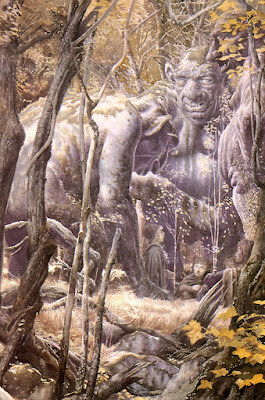
Art by Alan Lee

I talked in In Search of Better Travel Rules how random encounters that are just "Everyone makes a Travel check to navigate the marshes or takes 1d6 HP damage" are boring. No matter what the flavor is, rolling dice and taking an HP tax is not an interesting encounter. Random encounters need choice to be interesting.

In Walking Holiday, I laid out the basic procedure that I use: wandering encounters are combined with static, landmark encounters to create the scene the players find when they travel to a new location. Wandering encounters are basically Necropraxis's Overloaded Encounter Die. (Schwew, that's a lot of references.) 

Consider the troll scene in The Hobbit. This is actually a super gameable scene. The trolls all have names - they're not just Troll 1, Troll 2, and Troll 3. They are a strong enemy that has treasure, but must be fought or dealt with through stealth. They can be negotiated with somewhat - they even argue about whether to let Bilbo go at first. They have an obvious weakness to be exploited. 

Would that every encounter on a random table was so rich with possibility.

For the wandering encounters in this generator, there are four possible types: 

  1. Curiosity: These are basically "nothing happens," but framed to give context and flavor to the environment.
  2. Sign: These are hints at hazards or monsters that live in this area. Because there are only about a dozen of these, these programmatically happen only about half as frequently as other encounter types.
  3. Travel Event: These are scenes that provide open-ended problems to avoid a hazard or gain some reward. There are about twenty of these.
  4. Encounters: These are scenes with friendly or unfriendly NPCs. There are hundreds of these.

Each time an encounter is rolled, it is marked off of the list. Your generator won't give you that result again until you refresh the page.

For Encounters, it's vital that these are never framed as "1d4 red dragons." Some random tables try to randomly provide activities for the monsters and this can sometimes produce weird results like "3 skeletons are dancing." Luckily, d4caltrops provides lots of inspiration here as they have d100 monster activities for each creature in the Monster Manual (including interesting variations on only barely different monsters - such as pirates vs buccaneers). 

Encounters should be a mix of both friendly and non-friendly NPCs. Moreover, almost no entry is "1d4 starving wolves attack." Almost everything can be talked to, almost everything can be handled outside of combat. 

The generator is doing a lot of work here. Each monster is assigned a type (hill troll vs stone troll), an appropriate number, and an activity based on the time of day. Friendly NPCs are given names. Trolls occur frequently (it's a region called the Trollshaws after all) but only occur at night.

This generator was made as an experiment. If I was going to spend more time on it, I'd probably bake a weather hex flower into it and give the unfriendly NPCs names as well.

Anyway, I hope there's something worthwhile here for you!