Showing posts with label Errantry. Show all posts

Wednesday, January 10, 2024

Resolutions in the FLAME Imperishable

On my RPG writing roadmap, I have a capsule game of my own, tentatively called Tormented Hills and Unharvested Seas. (I first mentioned the germ of this idea, here).

The underlying system of this game has its own cute, bespoke name: the FLAME Imperishable system

Mr. W.F. Smith of Prismatic Wasteland has issued a challenge:

My challenge is thus: In January 2024, come up with a new resolution mechanic for a TTRPG and give it a name. It doesn’t need to be good (in fact, most the good ones have probably already been taken). It just needs to be new! You don’t need to plan to use it in your games; it can be absolute detritus for you. But one blogger’s trash is another designer’s treasure. You never know how great an impact one throwaway idea on a blog might have.

Because I am easily peer pressured, I will debut this system for you now. It will both be an example of capsule game mechanics, and also fulfill this challenge. 

The Flame Imperishable

When you have time, gear, and skill, your adventurer can overcome almost any obstacle. If you lack one of those elements, you must test fate. 


When you test fate, roll a pool of six-sided dice. This pool starts at 0, and you add 1 to the pool for each one of the following you have. 


Fellowship - Add a die if someone helps you with the task.

Lore - Add a die if you have a Lore that is relevant to the task.

Attribute - Add a die if one of your Attributes would be helpful.

Magic - Add a die if you use one of your magical abilities to accomplish the task.

Equipment - Add a die if you have the right tool for the job.


Look at your dice:

, : Miss

, : Near miss

, : Hit

If you get at least 1 hit, you succeed. 


For every additional hit, you can add one detail to your success (say "yes, and…"). You might accomplish your task quickly, impressively, thoroughly, effortlessly, and so on.

You can stress one of the assets you rolled (Lore, Attribute, Equipment, etc.) to turn a near miss into a hit. Stressed assets are refreshed during downtime. 

And there you have it. A simple dice pool system. The goal of this system is to never do math. No addition, no subtraction, no derived stats, no counting HP. 

Friday, August 11, 2023

Pointcrawling Character Creation

The blog that brought you hexflower character creation now brings you....POINTCRAWLING CHARACTER CREATION. 

You have been invited to the Counsel at Aben Garan. You must travel through the world, braving the fortresses of the enemy (skulls), exploring ruins, crossing natural wonders (stars), and visiting holdfasts (castles) to reach your destination. The adventures along the way have made you who you are today.

I like this method because it ties each of the things on your character sheet to a specific moment, a specific storypoint. This method threads the needle between a three-page navel-gazing fanfiction backstory and "Dirk Jr, Human, Fighter 1."

A noble click embiggens the smallest map.

Start at one of the castle holdfasts at the outer edge of the map. You begin with the special feature or ability of that holdfast. 

The starting holdfasts are:

  • Willand Corners, the sleepy home of burrowers and rustic men
  • Whitebeacon, capital of the stalwart Ondians, inheritors of the legacy of the First Men
  • Haven Tree, birthplace of the elven folk
  • Baranar Kalan, the deepest delving of the dwarves

You have five seasons to reach Aben Garan. Each season, draw a line to another named point and gain the feature of that location. 

For every season you arrived at Aben Garan early, increase one of your attributes by +1.

The Locations


Baranar Kalan

Long has the Shadow been held at bay by the valor of the dwarves of Baranar Kalan. You have stood with them, fighting the legions of trollspawn beneath the earth and raiding corsairs from the north.

Boon: You gain +2 Attack.

Blood Swamp

Littered with the corpses of armies, fellowships, and travelers foolhardy enough to try to cut through it. In the eerie glow of bioluminescent flora, you are attacked by a bloodwyrm but manage to fend it off. 

Boon: You gain +1d8 HP.

Corsair's Cove

A wretched hive of scum and villainy. You survived here by your wits more than your skill with the blade, as even the mightiest warrior might meet an untimely end in a dark and narrow alley.

Boon: You gain a clever wallet. Your wallet is enchanted with a squeaky voice. If it is ever picked, it will squeal an alarm. If it is ever empty, it will chastise you for being a spendthrift.

Feasting Forest

In the Feasting Forest, the druids ask you riddles in exchange for your life. You answered their questions, and drank from the star-scattered waters of their sacred pool. 

Boon: You gain the ability to Speak with Animals.

Goblinhole

Deep within the depths of Goblinhole, a labyrinth of twisting passages leads to a city where  goblins barter curiosities and trinkets in exchange for stories of the world above. You've traded with them and come out the better for the bargain. They have not forgotten it.

Boon: You gain a goblin bomb. It would be clumsy to use in combat, but you know too well how they can be used to blow open doors, collapse sections of the mine, or cause other destruction.

Guth-Gulaenar

Built to be an impregnable castle. Now, a ruin. You ventured within to learn if it was truly haunted. You found no ghosts, but did find a treasure of ancient days.

Boon: You gain an auroch hunting horn. When blown, members of your fellowship will always hear the call - no matter how far away they are. In the wilds, you have a 2-in-6 chance of attracting outside help. When blown near your home haven, this is a 6-in-6 chance.

Haven Tree

Beneath the towering branches of the Haven Tree, you shelter from the endless march of the outside world. You have learned much from the stories of the elven inhabitants.

Boon: You are a Loremaster. When you bid lore, you may ask a follow up question for free.

Kel Tanenhen

The hilltop home of the brave and honest Free Men, a city-state of humans who self govern. While dwelling among them, you taught them some of your people's crafts. In thanks, they wove you a gift.

Boon: You gain a golden-threaded banner, proudly displaying the arms of your house or realm. When carrying it into battle, you have advantage on attempts to route and drive your foes back.

Lake of Jack in the Green

An elven boatman gives you passage to the island in the center of the emerald lake. Here, you find the ruins of the First Men, and take a cutting of an ancient tree.

Boon: You gain the living tree staff. As long as you carry it, it lives and grows. Wherever you choose to plant it will be blessed indeed.

Landennvein Forge

The Landennvein Forge once boasted the finest dwarven artisans in all the land. The anvil is now is silent. You found some of their ancient material, yet unworked. 

Boon: You gain an ingot of moonsilver. Moonsivler is more precious than gold, for it is both beautiful and useful for all metalcrafts. What will you make this ingot into?

Lautur'Skelleth

Lautur'Skelleth, also known as the Corpsehead Keep, was once the city of necromancers. The sorcerer-kings have now joined their subjects in the lands of the dead. In the shadow of those towers, you plucked an ancient and rare herb

Boon: You have a single leaf of very rare Queensfan herb. Place it on the mouth of one mortally wounded and they will recover if there is even a flicker of life left within them.

Mistymere

Beside the tranquil expanse of the Mistymere, a lone figure contemplates the ripples on the water's surface, their thoughts drifting to distant shores and forgotten tales. You surprised her in her contemplations, and when she saw you had no evil in you, she gave you a gift. 

Boon: You are a Skinchanger. When you put on the swan-feather cloak, you take on the form of a white swan.

Shivering Lake

While fishing on the Shivering Lake, you pulled up a river maiden. She traded you a better net in exchange for her feedom.

Boon: You gain the river maiden's fishing net. It rarely needs mended, and almost always produces a catch.

Tarmaen Hole

Burrowers claim that they once dwelled in Tarmaen Hole, but were forced out by some nameless evil. If those gentle folk ever lived here, the land tells no tale. Nothing green grows here. It is a ruined heath. While passing through these lands, you rescued Windproud the queen of eagles from a tar pit. 

Boon: You have a golden feather of Windproud. If you are ever in need, release the feather onto the wind and she will come to you.

Throne of Sight

The ruins of an Andantine fortress set high on a mountain. After an arduous trek, you beheld a view unrivaled throughout the Wilderlands. You saw many far off places as if they were brought near to you.

Boon: You are Sharp Eyed. You will always act during a surprise round.

Throne of Sound

The ruins of an Andantine fortress set deep in a bowl. Climbing down, many sounds from far way places seemed near at hand. You achieved an understanding most consider uncanny.

Boon: You are Sharp Eared. Once per session, ask the GM for a random rumor.

Tomb of Bandor the Bereft

Bandor was a king of Ond who commanded his wife, his son, his knights, and his entire retinue to be buried with him. This last act of arrogance laid a curse upon the Tomb, as well as the deep valley that surrounds it. You braved only part of the passages beneath the earth, claiming a treasure from the shadows that therein dwell.

Boon: You gain a dagger of star iron. This ancient dagger never needs to be sharpened and always keeps its edge.

Tomb of the First Men

Beside the ancient stones of the Tomb of the First Men, you puzzled over the star signs writ in stone.

Boon: You gain a broken runestone. It is said that the First Men made henges of runestones to travel quickly across the land in ancient times. They are now broken. You have a piece that fits into one of these runestones. If you can find the right henge, perhaps you can make it work one last time?

Trollbog

The trollspawn crawl up from a blight in the very earth itself. You have stood against them for a time.

Boon: You are a Shieldthane. As a maneuver, you may create a shield wall if you have at least two other companions who also carry shields. 

  • The shieldthane “leads” the shield wall. They gain a +2 bonus to their attack roll by being in the shield wall. Other players in the shield wall cannot attack. 
  • Damage done to a shield wall may be split up in any way between the participants. For example, a troll’s hammer dealing 12 damage may be split up as 6 damage to one participant, 3 damage to a second, and 3 damage to a third. You gain 1d8 additional HP. 

Uldvoton Hall

Though an ancient ruin, refugee dwarves are settling here and forming a colony. You trade stories and gear with them.

Boon: You are a Wanderer. You gain 2 pack slots.

Whitebeacon

In the last Age of the world, the Shadow spilled the seas and dried the oceans. The Andantine Isles are now only a ruin and a memory. Whitebeacon is one of the last outposts of this ancient culture: they still tell of heroes, devils, titans, and monsters.

Boon: You are a Dwimmer-crafty. You may combine herbs to cast spells.

Willand Corners

A crossroads town, straight down the King's Highway. Here and here alone is the curious but agreeable custom of human and burrower living together practiced. You have dwelt among them and learned some of their horse sense and wisdom.

Boon: You are a Sneak. At any point, you may declare that you go sneaking. This allows you to go dramatically off-stage. Later, if you are not present in a scene and it’s at least somewhat plausible that you could have snuck there, take 1d4 damage to arrive on the scene dramatically. 

If you go sneaking and all tension evaporates, you may rejoin the scene by slinking out of the shadows. This does not cost HP.

Wispwood

Amidst the whispering trees of Wispwood, fauns and dryads dance in the moonlight, beckoning travelers to join their otherworldly revelry and lose themselves in a realm of enchantment. You did so, and come out changed.

Boon: You are Faun-footed. You have little hooves. You (and everyone you are with) may travel through forest hexes as if they had a road.

Example

Let's make a character together. 


To start, we'll choose a starting castle holdfast. We'll make a burrower because I like little dudes. We'll start at Willand Corners, where burrowers live. We gain the Sneak ability.

(Ostensibly, you could have a burrower character come from any holdfast on the map if you wanted to do a "Character raised by another culture" schtick.) 

Then, we just start connecting the dots as we go towards Aben Garan. We have five stops we could potentially make.

Our first stop is Landennvein Forge. We gain an ingot of moonsilver. Maybe we got the moonsilver ingot by sneaking through the ruins? When game starts, we can trade this as Treasure to an NPC or find an opportunity to forge it into something wondrous.

Our second stop is the Lake of Jack of the Green. We board an elven boat and get a living tree staff. I love that for our burrower. I can just picture a little guy with an over-tall walking staff that's literally growing leaves. I imagine that I want to take it back to Willand Corners and plant it there as a goal, but who can say what will happen during play?

Our third stop is Goblinhole. There, we trick some goblins and get a goblin bomb. Bombs are always useful in play.

We have two more potential stops, but I want some extra attribute points for my guy, so I cut directly towards Aben Garan. Since we arrive two seasons early, we get +2 points to our attributes. We could have taken the long way around, but I'm happy with this character as he is.

Making Your Own Map

You can make your own map with image editing software using the assets provided here. You can add new locations to the map. You can remove these and write wholly original holdfasts, dungeons, etc. 

Leveling Up With Pointcrawling

Why stop at character creation? Use this system to handle character advancement, too. 

After every adventure, you can spend a downtime season to journey to any location on the map and gain the benefits of that place. As you travel, you will find more locations and gain more options!



Monday, January 17, 2022

Councils [Wilderlands, Errantry]

Preamble: I found these rules buried in an early, early, early His Majesty the Worm draft. I pulled them out and cleaned them up. I think they fit nicely in my Wilderlands/Errantry series since it is obviously inspired by the work there.

If you want to know how I eventually did "social encounters" in His Majesty the Worm, check out my post here.

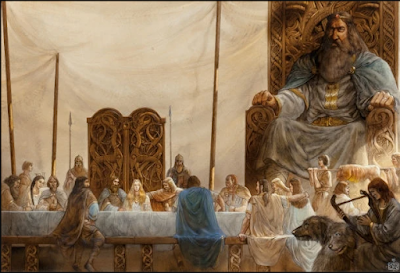
by John Howe

"In a great hall with pillars hewn out of the living stone sat the Elvenking on a chair of carven wood. On his head was a crown of berries and red leaves, for the autumn was come again. In the spring he wore a crown of woodland flowers. In his hand he held a carven staff of oak.

Long and searchingly he questioned the dwarves about their doings, and where they were going to, and where they were coming from; but he got little more news out of them than out of Thorin. They were surly and angry and did not even pretend to be polite."

- The Hobbit

Use these rules when the player heroes are trying to convince a person or group of a particular thing, or when they’re trying to illicit action from another person on their behalf. This could be at a bandit’s war council, at a trial, or at a folkmoot.

When a Council is called, it’s important to determine who the deciding person is. Are you talking to a local leader directly? Are you speaking to stir up the people? Are you trying to convince several people of your plea—perhaps begging help from an assembled gathering of kings from different realms?

The Body of Arguments

At the beginning of a Council, the GM must decide the Body of Argument. These are the reasons why the NPCs are reluctant to accept the PC’s proposal. If the GM can’t think of any arguments against the PC’s plan, the NPCs should merely acquiesce to the PC's course of action.

Most Councils have about three arguments. Councils that are inclined to favor the player heroes might have fewer (as few as one argument, even) and more antagonistic Councils might five (or more!).

An argument is just a short phrase that sums up a major concern. Write each down separately. These arguments are the talking point for the GM’s characters during the Council.

Sample Arguments

  • Helping you would draw the ire of the Winter Witch, which we can ill afford. 
  • This would cost too much money.
  • The time involved would drive me away from my fields during harvest.
  • Your rival has offered to pay me more to do the same for him.
  • This way is too dangerous at this time of year.
  • This is not our affair—we must mind our own business.
  • What you propose would aid our ancient foes, who wrongs against us we have not forgotten.
  • Your errand is impossible. It is a waste of time for me to help one afflicted with madness.
  • This plan would offend the Fair Folk nearby. I’ll have no part of it.
  • I am afraid of the magic that you are said to wield. I’ll not meddle with witches and wizards.
  • I’m a simple man, much to unimportant to actually make a difference. You should ask somebody that can actually help.

GM Note: I find it useful to  jot down the arguments on separate note cards. Then, when a particular argument is “defeated,” I just turn the note card over. It’s nice for me to have these things written down in front of me for easy reference.

A player hero makes their case by role-playing what they’re saying. If the GM determines that this argument is relevant to a particular argument, the player makes a relevant skill test. If the roll is successful, one of the arguments is “defeated.” That particular reasoning no longer troubles the decision maker, or it is no longer deeply relevant to the point at hand. 

When all the arguments are defeated in this manner, the Council will rule in favor of the player heroes.

However, every time a roll is failed, the player hero has failed to make a convincing argument and tested the patience of the decision maker. The Council will decide against the player heroes once a certain number of failed rolls occurs. 

The Council's tolerance for failed arguments is [number of arguments -1]. So if there are three arguments on the table, the Council will move against the PCs after 2 failed rolls.

Focus during Councils

As opposed to battles of arms, Councils do not rigidly track who goes first and who is doing what. The fellowship is typically considered “one side” and any antagonists are considered “another side.” Both have a chance to speak in turn, rebutting or building on arguments as they go. GMs can adjudicate this however makes the most sense, but typically there is only one speaker and one dice roll per side per turn. 

A fellowship might call on the most sociable person—the person with the highest skill—to make almost all of their rolls. In this case, that player must role-play the arguments made. Other player heroes might speak up on the fellowship’s turn when they have what they consider to be a very good argument. When they speak up, they roll instead of the normal speaker. This sort of “butting in” usually happens organically. 

Sometimes only certain player heroes might be the only ones who can plead their case. For example, only one of noble blood might be able to speak at a council of kings. Or only a woman might have the right to speak in the Women’s Circle of the village.

Disposition in Councils

Disposition affects your dice rolls during council. If the argument that you are role-playing would appeal to a particular disposition trait possessed by an NPC, the GM may tell you to roll with advantage. However, if your argument would contradict or displease a particular disposition trait, the GM can tell you to roll with disadvantage.

Consider this example. You are trying to beg support of a king in your errand to rescue your stolen love from a dragon. The king does not like the idea of strangers on his land and is worried that stirring up the dragon will create trouble for his people. The king is chivalrous, stubborn, and materialistic. As you try and convince him of your need, you mention out loud that rescuing the weak from the strong is the responsibility of any true hero. The king, being chivalrous, can’t help but agree. Your roll to convince him is made with advantage. Then, you try to dissuade his fears of the dragon’s wrath, and compare a few fields to the life of an innocent maid. The king does not like to hear of crops and fields burning, being materialistic. This roll is made with disadvantage.

GMs, as always, should grant advantage/disadvantage for good ideas or bad ideas, as they see fit.

Discovering Disposition

When you observe a character in a back-and-forth exchange, you—as the player—should have a fairly good idea about what disposition traits they have. The GM will be hamming these traits up.  

Bidding Lores and Disposition

You can attempt to bid lore to find out more about the characters around you. If the GM accepts that your lore is relevant, they will tell you one of the NPC’s disposition traits. If, for example, you have Court Lore, you can ask “What is one of the local steward’s dispositions?” The GM will consult their notes and say that he is a definitively Greedy man. The player heroes can then use this to their advantage as they try to navigate the world of castle life.

Persuasion Isn’t Domination

One cannot hit the moon with an arrow, no matter their Strength score. Neither can you persuade a random off-the-street NPC that they’ve been transformed into a donkey, that you’re their rightful king in disguise, or that they should cut off their arm for you. Sometimes the players will try to use social skills to convince NPCs of the most unrealistic things. After all, he’s just a stupid NPC and look how many points I’ve put into all these social skills! 

This is not how the game is intended to be played.

Skill rolls help players curry favor with their rhetoric. Even so, the player must first have an oration that is plausible to defeat a particular argument.  

When a player hero tries to use persuasion in scenarios that stretch believability, just say no. The NPC chuckles in amusement at the bizarre nonsense. If they persist, the NPC might get angry—or fear for his life while talking to this dangerous lunatic.

Tuesday, November 10, 2020

Diegetic Classes [Wilderland]

 Cavegirl introduced me to the term diegesis last year. In this past year, I’ve seen amazing content come out of the indie/OSR space, aligning tons of rules to the fictional world. 

I am super into this. I have sensed that my preferences lie with the diegetic since before I learned the word. Way back in my LARPing days, I knew it was better to roleplay with bloody bandages than say “I heal you 1, I heal you 2, I heal you 3.”


The Future of Wilderlands

This is tagged as Wilderlands content because I have plans to collate and collect as much of this content as I can into a zine called Errantry


Errantry will be a zine, a new DIY/SWORDDREAM/OSR game, a hexcrawl setting, and a campaign. It will have lots of blanks for people to build it out and adapt it to their table. 


That’s the plan anyway. More on this later. 


A Class on Classes

D&D has never been super clear whether its class paradigm is diegetic or non-diegetic. Is a monk an ascetic martial artist from Kara-Tur or a generic template for someone who fights unarmed? The more editions that passed, the less specific it seemed.


On the other hand, 3E’s prestige classes always seemed very specific and diegetic. You weren’t just a fighter, you were one of the Cormyrian army’s Purple Dragon Knights. This was fun in theory but wasn’t successful. It never mattered what your character did or said in the game, only that their Intimidation and Rope Handling were 9+ or whatever. 


When I discovered OSR-style play in G+, I was thankful to get away from builds, level planning, feat acquisition and such. If I gained a knighthood during play, I was excited for whatever the GM said that meant. 


But what if...


Diegetic Classes for the Wilderland

“That would be no good,” said the wizard, “not without a mighty Warrior, even a Hero. I tried to find one; but warriors are busy fighting one another in distant lands, and in this neighbourhood heroes are scarce, or simply not to be found. Swords in these parts are mostly blunt, and axes are used for trees, and shields as cradles or dish-covers; and dragons are comfortably far-off (and therefore legendary). That is why I settled on burglary —especially when I remembered the existence of a Side-door. And here is our little Bilbo Baggins, the burglar, the chosen and selected burglar. So now let’s get on and make some plans.” 

  • The Hobbit, J.R.R. Tolkien


Levels aren’t diegetic. Get rid of them. 


Traditional classes aren’t particularly useful either. Get rid of those, too. 


In the Wilderlands, there are various organizations, tribes, cults, and sects. Membership in these organizations grants certain benefits. These are called classes


When you speak to a member of an organization, they will (almost always) tell you what you what quest you need to complete to join their ranks. This is never tied to your statistics; this is always some thing your character must do in the world. 


If you join a class, you gain some boon. This is some discrete and useful ability. 

(This may be thought as being roughly analogous to a single template in the GLOG.)


Some classes are mutually exclusive. For example, you may never be both a Knight of the Grail and a Blackguard.


You begin your career as an adventurer with no classes. Adventure and earn them in play.


The classes listed below are explicitly appropriate for the Wilderlands setting. Your game world should probably have different ones. Write some up and let your players discover them. (Hint: Look at the level titles and concoct a few based on those.)


Berserk

Quest: You must slay, skin, tan, and create a coat from the hide of a dire animal. 

Boon: If you wear your dire coat, but no actual armor, you may choose to fly into a berserker fit.  While in this fit, you may only perform Melee attacks, but you gain damage resistance 2. This fit only ends when every creature who has attacked you is dead or you are. 


Bravo

Quest: You must challenge and best another bravo in a fair duel.Thereafter, as a bravo, you must accept any fair challenge from any duelist. 

Boon: You gain +2 to hit. 


Burglar

Quest: You must join the Burglar’s Guild, whose membership dues cost 1 Treasure. 

You cannot be both a Burglar and have Knightly vows. 

Boon: At any point, you may declare that you go sneaking. This allows you to go dramatically off-stage. Later, if you are not present in a scene and it’s at least somewhat plausible that you could have snuck there, take 1d4 damage to arrive on the scene dramatically. 


If you go sneaking and all tension evaporates, you may rejoin the scene by slinking out of the shadows. This does not cost HP.


Champion

Quest: You must make an oath of service to a lord from your realm and hold them as your liege. 

Boon: You gain 1d8 additional HP. 


Druid

Quest: You must make an appropriate sacrifice to Green Gods at the Tree of Faces inside the Myrkvith Forest. The Tree of Faces hungers for many strange things, but nothing more than the decapitated heads of orcs, who despoil trees. Thereafter, you may not carry works of iron.

Boon: When you apply one of the nine sacred herbs for healing, your ministrations heal 1d4+1 points of damage (instead of 1).


Knight Errant

Quest: You must slay a monster and present its head to the Folkmoot. If they accept your offering, they will dub you a Knight Errant. 

You may not be a member of two orders of knighthood at the same time. 

Boon: If you have not told a lie since the last new moon, you may ask “Is what they just said true?” in response to any statement from an NPC. The GM will answer you honestly. You may do this once per day.


Knight of the Green

Quest: If you drop to exactly 0 HP and recover, you may thank the Green Gods for their blessing and dedicate yourself to their cause.
You may not be a member of two orders of knighthood at the same time. You may not worship two pantheons at the same time.

Boon: You (and everyone you are with) may travel through forest hexes as if they had a road.


Loremaster

Quest: If you find an ancient book of lore, the GM presents you with a sudoku puzzle with runes instead of numbers. You must solve this puzzle out of character.

Boon: You may now spend a dungeon turn to read any runes you encounter.


Ranger

Quest: Write an in-character field journal documenting 15 hexes

Boon: You may use a Camp Action to scout nearby. You investigate a specific location in your hex or an adjacent one. Thereafter, you may ask the GM three specific yes or no questions about something you’d know having infiltrated that location, e.g., “Is this door trapped?” “Is this room guarded?” “Is the wizard’s bedroom on this level?” “Do the bandits have bows?” “Were the orcs green-skinned?” 


Shieldthane

Quest:

Boon: As a maneuver, you may create a shield wall if you have at least two other companions who also carry shields. 

  • The shieldthane “leads” the shield wall. They gain a +2 bonus to their attack roll by being in the shield wall. Other players in the shield wall cannot attack. 

  • Damage done to a shield wall may be split up in any way between the participants. For example, a troll’s hammer dealing 12 damage may be split up as 6 damage to one participant, 3 damage to a second, and 3 damage to a third. 


Skald

Quest: Best a supernatural creature in a riddling contest

Boon: When you bid lore, you may ask a follow up question for free.


Skinchanger

Quest: Skinchangers put on a cloak of hide from the animal whose shape they wish to take. The ritual needed to create this magical cloak is known to few, but you know a rumor of at least two: Grimbold the Berserk of Northmark and Alianora of Svanlindale. Seek either of them out to learn this art. 

Boon: If you don your cloak of hide, you may take on the shape of an animal. In this form, you gain no new stats, but you may leap, climb, slither, bite, swim, or fly as a beast. 


Sorcerer

Quest: On a night of the new moon, open one of the barrows of Northmark and plunder the Treasure you find there. If you survive the encounter, you will surely be called a sorcerer.

Boon: A sorcerer may cast one the spells of wilderlands for each item of enchantment they hold.


Wizard

Quest: You must pay 1 Treasure and spend a Downtime Action to take classes at the Tower of Grammarye. Each time you do this, you learn the lore of one of the noble herbs. 

Boon: Each time you gain this class (which may be done up to nine times), you are shown a row in the chart which represents the combinations of herbs into magical reagents. You may prepare these reagents as a Camp action. 


Further Reading:

Unbeknownst to me, my cohort Chris at Wayspell posted a very similar system a few hours back. We didn’t collaborate on this...but now we’re going to (and by that, I mean I’m going to steal his content). Give his system a read too.


Sunday, April 14, 2019

Character Creation in Wilderland


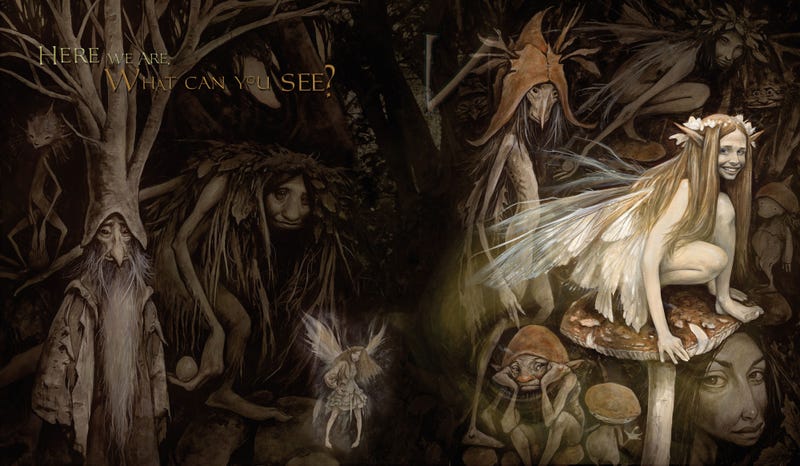
Brian Froud, How to See Faeries


What a happiness this must have been seventy or eighty years ago and upwards, to those chosen few who had the good luck to be born on the eve of this festival of all festivals; when the whole earth was so overrun with ghosts, boggles, bloody-bones, spirits, demons, ignis fatui, brownies, bugbears, black dogs, specters, shellycoats, scarecrows, witches, wizards, barguests, Robin-Goodfellows, hags, night-bats, scrags, breaknecks, fantasms, hobgoblins, hobhoulards, boggy-boes, dobbies, hob-thrusts, fetches, kelpies, warlocks, mock-beggars, mum-pokers, Jemmy-burties, urchins, satyrs, pans, fauns, sirens, tritons, centaurs, calcars, nymphs, imps, incubuses, spoorns, men-in-the-oak, hell-wains, fire-drakes, kit-a-can-sticks, Tom-tumblers, melch-dicks, larrs, kitty-witches, hobby-lanthorns, Dick-a-Tuesdays, Elf-fires, Gyl-burnt-tales, knockers, elves, rawheads, Meg-with-the-wads, old-shocks, ouphs, pad-foots, pixies, pictrees, giants, dwarfs, Tom-pokers, tutgots, snapdragons, sprets, spunks, conjurers, thurses, spurns, tantarrabobs, swaithes, tints, tod-lowries, Jack-in-the-Wads, mormos, changelings, redcaps, yeth-hounds, colt-pixies, Tom-thumbs, black-bugs, boggarts, scar-bugs, shag-foals, hodge-pochers, hob-thrushes, bugs, bull-beggars, bygorns, bolls, caddies, bomen, brags, wraiths, waffs, flay-boggarts, fiends, gallytrots, imps, gytrashes, patches, hob-and-lanthorns, gringes, boguests, bonelesses, Peg-powlers, pucks, fays, kidnappers, gallybeggars, hudskins, nickers, madcaps, trolls, robinets, friars' lanthorns, silkies, cauld-lads, death-hearses, goblins, hob-headlesses, bugaboos, kows, or cowes, nickies, nacks necks, waiths, miffies, buckies, ghouls, sylphs, guests, swarths, freiths, freits, gy-carlins Gyre-carling, pigmies, chittifaces, nixies, Jinny-burnt-tails, dudmen, hell-hounds, dopple-gangers, boggleboes, bogies, redmen, portunes, grants, hobbits, hobgoblins, brown-men, cowies, dunnies, wirrikows, alholdes, mannikins, follets, korreds, lubberkins, cluricauns, kobolds, leprechauns, kors, mares, korreds, puckles korigans, sylvans, succubuses, blackmen, shadows, banshees, lian-hanshees, clabbernappers, Gabriel-hounds, mawkins, doubles, corpse lights or candles, scrats, mahounds, trows, gnomes, sprites, fates, fiends, sibyls, nicknevins, whitewomen, fairies, thrummy-caps, cutties, and nisses, and apparitions of every shape, make, form, fashion, kind and description, that there was not a village in England that had not its own peculiar ghost. Nay, every lone tenement, castle, or mansion-house, which could boast of any antiquity had its bogle, its specter, or its knocker. The churches, churchyards, and crossroads were all haunted. Every green lane had its boulder-stone on which an apparition kept watch at night. Every common had its circle of fairies belonging to it. And there was scarcely a shepherd to be met with who had not seen a spirit!


- The Denham Tracts: A Collection of Folklore : Reprinted from the ..., Volume 2, by Michael Aislabie Denham


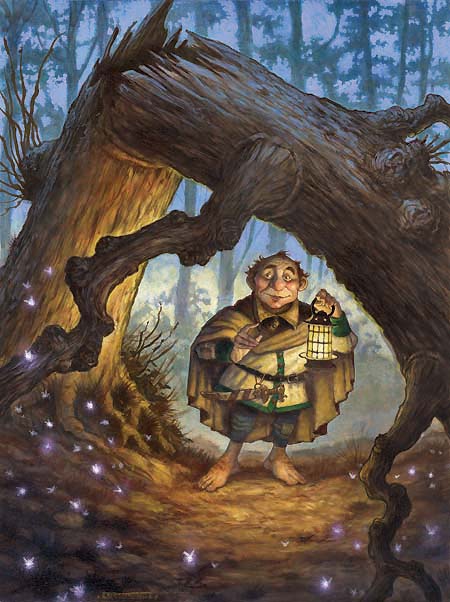
This is a continuation to the work begun in my post 1937 Hobbit As a Setting, and continued sporadically for the past...two years?! Maybe one day I'll pull this stuff into a zine.


This post only covers hobbits. If I didn't break this work up, it'd never get done. 

Character Creation Procedure

  • The mini-game of character creation is done together as a table. 
  • Each player draws three Tarot cards. Each card drawn represents three phases: childhood, youth, and first adventures.
  • Each race has a starting score of the six attributes + Attack bonus. 
  • The minor arcana cards are Branching Paths: they correspond to questions the GM asks the player. 
    • For each answer the player makes, the GM instructs them to place a + next to one of their seven stats.
    • If the player draws the same number twice, they just double down on the original answer. Put another + next to the stat again. 
  • Each major arcana card represents Signs and Portents. It gives the PC a unique ability and (usually) a special item. 
  • After the 2nd card is drawn, roll a d50. Gain a random former Profession. Note this profession down as a Skill
  • After the 3rd card is drawn, tell a story to the table about your first adventure. Tell everybody why you're adventuring. Write down a Skill based on this story. 
  • At the end of character creation, total the amount of +s. The first + gives +2 to that stat. Each subsequent + after the first adds +1. 
  • Choose a name and write down a description. Throw your character into danger!

Starting Scores for Hobbits

Hobbits have the following starting scores for their seven stats. Note these down and adjust them using the character creation procedure: 
Str 8, Dex 14, Con 10, Int 10, Wis 12, Cha 12, Atk 8

Players draw three Tarot cards representing things that happened in three phases of their life: childhood, youth, and first adventures. 

Branching Path Questions

Tony Diterlizzi, from Dragon magazine

If you draw a minor arcana, consult this table. Tell the GM your answer. They will tell you to put a + next to one of your stats. 

At the end of character creation, note down each stat you placed a + next to. 
For the first +, increase the stat by 2. Each subsequent + increases the stat by 1. 

I. The cow went mad. Did you get it back to the pasture or get knocked out by a stray hoof?
II. Do you prefer digging new tunnels or harvesting the mushrooms?
III. When you visited your grandparents' hole, did you prefer to listen to the fables of your granny or practice conkers with your gaffer?
IV. Do you consider yourself a respectable gentle-halfling, or have you always been a troublemaker?
V. When the wolves came howling in the winter, did you bring back a skin or were you savaged?
VI. Do you always eat second breakfast, even if supplies or short? Or do you tighten your belt and make sure there's enough to last?
VII. When your brothers pinned you down, did you wrestle with them or craft a hilarious vengeance? 
VIII. When at the local pub, do you prefer to listen to stories or weave tall tales?
IX. The bully demanded a challenge for perceived wrongs. Did you best him in a riddling contest or leg wrestling?
X. When the Big Folk came to trade, did you try and learn their language or did you heed your gaffer's warnings about looking up too much?
Page. When she asked you if you wanted to tumble in the hay, did you follow her to the hay loft or finish your chores?
Knight. Do you prefer to trade stories at the local pub or wander far afield by yourself?
Queen. At the village fair, you made a name for yourself. Did you win the archery contest or the arm wrestling contest?
King. When the goblins came, did you flee into the boltholes or take up torch and pitchfork against them?


Branching Path Answers

SPOILER ALERT. The following answers should be read only by GMs! Players give their answers, and GMs tell the players which stats to +.

I. If you brought it back to pasture, +Strength. If you got knocked out, +Constitution.
II. If you like digging new tunnels, +Strength. If you're more into mushrooms, +Dexterity.
III. If you prefer your granny's fables, +Intelligence. If you prefer conkers with the gaffer, +Dexterity.
IV. If you're a gentle-halfling, +Charisma. If you're a troublemaker, +Dexterity.
V. If you brought back a wolf skin, +Attack. If you were savaged, +Constitution.
VI. If you always eat second breakfast, +Constitution. If you tighten your belt, +Wisdom.
VII. If you wrestled with your brothers, +Attack. If you played the long game, +Intelligence.
VIII. If you sit back and listen, +Intelligence. If you weave tall tales, +Charisma.
IX. If you riddle, +Wisdom. If you leg wrestle, +Strength.
X. If you try and learn from the Big Folk, +Intelligence. If you listen to steer clear, +Wisdom.
Page. If you go for a roll in the hay, +Charisma. If you finish your chores, +Constitution.
Knight. If you trade stories, +Charisma. If you wander afar, +Wisdom.
Queen. If you win the archery contest, +Attack. If you win the arm wrestling contest, +Strength/
King. If you flee to the boltholes, +Dexterity. If you take up arms, +Attack.


Signs and Portents

Nicola Cuti, Luis Bermejo, El Señor de los Anillos, comic adaptation


If the player draws a major arcana during character creation, consult this table. There's no questions to ask or be answered. Just note down the special ability and the item gained.


The Fool (0) - You're lucky. Once per session, you may reroll one of your d20s. Gain a lucky rabbit's foot
The Magician (1) - You're suspicious. When there's magic around, it seems VERY queer to you. You can smell magic like the spell Detect Magic. To you, it stinks. Gain a magnifying glass. 
High Priestess (2) - You're shifty. You use a d8 when you make the Evade action. Gain a large shield. It basically covers your entire body. You have to hold it with 2 hands. 
Empress (3) - You're innocent. You can befriend a wild animal if you share some food with it. No dice rolls are necessary. You simply gain a new companion who will be friendly with you for as long as you're friendly with it. This ability may only be used once. Gain a ration of tasty mushrooms. 
Emperor (4) - You're an armor friend. You and iron have an understanding. If you don't get spotted, the iron won't get bent. You may move silently no matter what armor you're wearing. Gain a chainmail shirt. Dwarves made it, but it sort of fits you.
Hierophant (5) - You're a mockingbird. You can repeat or imitate any sound you've heard before so well that anybody will be fooled. Gain a piccolo
Lovers (6) - You're a pack rat. You have +3 inventory slots. Anything kept here won't be found, even if thoroughly searched. 
Chariot (7) - You're pony-wise. You can talk to ponies. Gain a pony. It always knows the way home to your hole. 
Strength (8) - You know the whistle way. If you're whistling, you can use your right hand as any type of common tool (hammer, awl, saw, bore, etc.). 
Hermit (9) - You have a knack. If nobody is watching you, you can perform an hour's worth of work in the space of a Turn. Gain a needle and silver thread
Wheel of Fortune (10) - You have the evil eye. Once per session, can force the GM to reroll a d20. 
Gain a weighted die
Justice (11) - You're canny. Once per session, you can ask the GM if the last thing you heard was a lie. The GM will answer honestly. Gain an almost unbreakable tea set
Hanged Man (12) - You're dodgy. Once per session, if an enemy misses you with an attack you can apply the same Attack roll vs any other target in range. Gain a set of fashionable clothes
Death (13) - You're a nasty little thing. If you wield a dagger and no shield, you deal 1d8 damage instead of 1d6. Gain your father's dagger. Give it a name. 
Temperance (14) - You can blow fat cotton. 1/day if you're smoking a pipe, you may generate a Fog Cloud. You gain a large, carven ancestral pipe
Devil (15) - You have an iron stomach. You make Saving Throws against poison with advantage. You win most drinking contests (unless your opponent is similarly blessed). Gain a bottle of rotgut liquor.
Tower (16) - You're evasive. If an effect allows you to make a Saving Throw for half damage, you instead take no effect if the Saving Throw is successful. Gain your mother's sling. Give it a name. 
Star (17) - You're a gourmand. You unerringly identify potions by just tasting a little of it. Gain a hermetic bottle. 
Moon (18) - You're quick. You have advantage on Wisdom checks for initiative. Gain a set of bandages
Sun (19) - You are tough in a pinch. You make Saving Throws against fear with advantage. Gain a lantern.
Judgement (20) - You're a doodlebug. If you use a dowsing rod, you can easily find the nearest source of water. Gain a willow wand
The World (21) - You're the team mascot. Once per session, you may allow another player to reroll one of their d20s. Gain a banner. What is the heraldry on it?

Failed Professions

Brian Froud
After step 2, roll to see what career you trained in. Of course, that life isn't for you, but you still know the basic shit. 

Roll d50
  1. Actor | Gain wooden sword (as club), disguise kit, mirror 
  2. Antiquarian | Gain swordcane, book of family history, quill, ink
  3. Barber-Chirugeon| Gain razor (as dagger), needle and thread, tongs
  4. Blacksmith | Gain hammer, a forge outside your hole 
  5. Bounder | Gain dwarven short sword, dwarf chain shirt, spyglass 
  6. Brewer | Gain mash paddle (as staff), empty bottle, small cask of ale (rich) 
  7. Butcher | Gain meathook (as ax), rations of dried meat (3), pet giant rabbit
  8. Carpenter |Gain saw (as ax), drill, nails, mallet
  9. Chandler | Gain candlestick (as club), candles (6), soap
  10. Clerk | Gain quill-trimming knife, blank book, quill, ink
  11. Cook | Gain rolling pin (as club), lard, cookpots
  12. Cooper | Gain crowbar (as club), small empty barrel, 50' of rope
  13. Courier | Gain walking staff, bird broach, bird whistle
  14. Farmer | Gain pitchfork (as spear), excellent tobacco, pet giant chicken 
  15. Farrier | Gain hammer, nails, saddle, pet pony
  16. Fletcher | Gain bow and 20 arrows, pet raven 
  17. Fisher | Gain net, fishing gear, tinderbox
  18. Gardener | Gain scythe, garlic (2), wolfsbane (2)
  19. Glassblower | Gain iron pipe, empty bottle, mirror, viewing orb
  20. Greengrocer | Gain sling and acorns, sack of cabbages, pet cat
  21. Haberdasher | Gain scissors (as dagger), bag full of buttons (as caltrops), needle and thread
  22. Hole-digger | Gain miner's pick, shovel, and 30' of rope
  23. Hunter | Gain bow and 10 arrows, camouflage winter-proof cloak, personal tent
  24. Knacker | Gain cleaver (as hand-axe), shovel, soap
  25. Landlord | Gain club, key to tavern 
  26. Leech | Gain pestle (as club), smelling salts, herbal poultice
  27. Locksmith | Gain crowbar (as club), lock and key, specialist's kit
  28. Lumberjack | Gain woodsman's ax (as battle axe), 50' of rope
  29. Mason | Gain hammer, chisel, block and tackle
  30. Methier | Gain knife, thick gloves, bottle of mead (rich), pet bee
  31. Midwife (woman only) | Gain silver knife, vial of holy water, herbal poultice 
  32. Miller | Gain rolling pin (as club), mallet, nails, bag of flour
  33. Minstrel | Gain elven short sword, lute, torch (3)
  34. Moneylender | Gain mace, scales, an IOU for [rank]d4 silver 
  35. Peat-cutter | Gain shovel, 10' pole, lantern, flask of oil
  36. Potter | Gain sling and potsherds, jar of clay, pottery studio/kiln outside of hole
  37. Rat-catcher | Gain club, sack, pet dog
  38. Rope-maker | Gain sling, 50' of rope, grappling hook
  39. Servant | Gain dagger, extravagant clothing, silver bell
  40. Shepherd | Gain sling, pan pipes, pet sheep 
  41. Sherrif | Gain quarterstaff, hat with tall feather, manacles  
  42. Tailor | Gain scissors (as dagger), needle and thread, extravagant clothing
  43. Tanner | Gain flensing knife, bag of salt, leather armor 
  44. Tax Collector | Gain dwarven short sword, chest, lock and key
  45. Town Drunk (a paid position) | Gain bottle of whiskey (decent), empty bottle, set of dice
  46. Truffler | Gain sling, really good mushrooms (3), pet pig
  47. Wainwright | Gain whip, wagon, pet pony
  48. Weaver | Gain quarterstaff, bottles of dye (3, any), banner of favorite tavern's sign
  49. Well-digger | Gain shovel, dowsing rod, 10' pole
  50. Whitesmith |  Gain hammer, bag of pretty but trifling jewels, ring that's almost magic

And there you have it! Note down your name and write a description of your character. 

Forthcoming posts will detail the tables for the other races.