Sunday, July 30, 2023

Monster Menu Playtest: Dungeon Meshi meets HeroQuest

While between tasks for launching His Majesty the Worm, I found myself with something I haven't had in the last few years: free time. I found being idle uncomfortable, so I made an ashcan of a game that was on my mind: What if HeroQuest could accommodate the storyline of Dungeon Meshi?

I played in a Dungeon Meshi space briefly before, as you might recall

I called this project Monster Menu. I put it onto paper just to get it out of my head. I used a lot of art resources that I had either already purchased or were free to use. I wrote in layout, which is something I've never done before. 

This ashcan version is available to check out. I'd love for you to play it with your friends. If you do, I'd love for you to tell me how it went!

There's a lot of gaps, but I hope you can figure them out. If there's something you don't understand or if something seems weird, just change it. HeroQuest is a game for young folks, and we have grown up. Ride this game hard and put it away wet.

Check out the playtest materials by clicking here or on the picture below.

Click here to check out the playtest materials


Saturday, July 8, 2023

On the Origin of Ents

Despite the inappropriateness of the format, I've made several long threads about Tolkien on Twitter.

As Twitter crashes and burns, I wanted to pull this one out. It's pretty good scholarship, I think.

-----

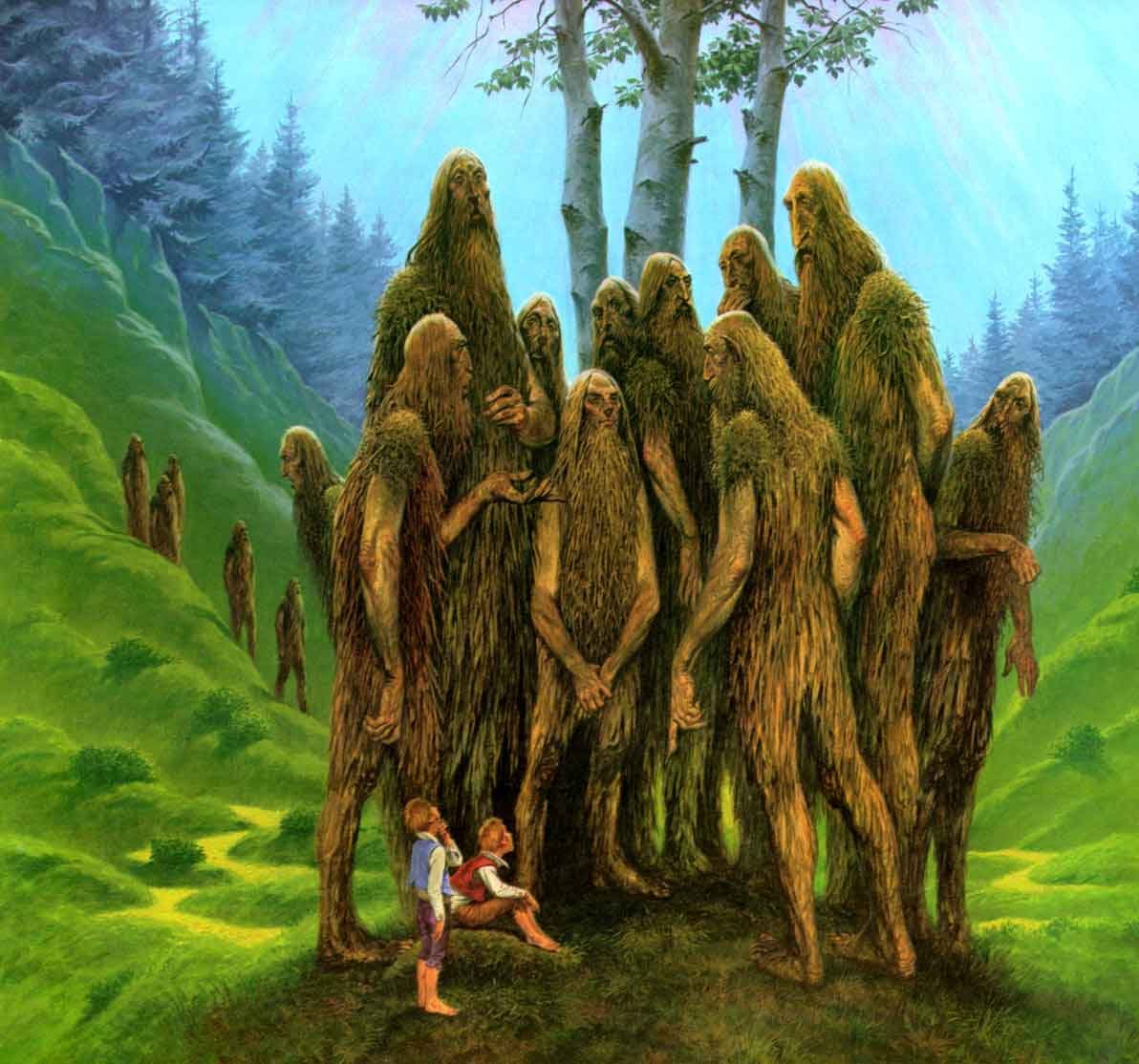
This is my favorite picture of Ents. It is by Darrel Sweet.

Introduction

I want to talk about both the origin of Ents, both within the mythos and also in Tolkien's writing process.

Caveat: Some ascribe a near mythical status to Tolkien, imagining that he had a perfect understanding of the entire corpus of written literature, and that his books were divinely inspired, unerring, and delivered on golden tablets. In truth, he was an ambitious writer who was constantly rewriting. I believe Tolkien would still be tinkering if he could.

One of the reasons that "Where did Ents come from" is a perennial question is because of Tolkien's editorial gaps. If the Silmarillion goes into all this detail about who gets to be Ilúvatar's special boy, what about Ents? If Treebeard is called the oldest creature, what of Tom Bombadil? What of the Elves awakening first? And what are we supposed to do about the connection of ents -> trolls that Treebeard mentions, considering Tolkien was refining his “problem of thinking evil creatures” up until his death?

(For that matter, what are we supposed to do about giants, who are only mentioned in an off-handed passage in The Hobbit?)

In Letter 180, Tolkien writes: "I have long ceased to invent...I have no recollection of inventing Ents...I wrote the 'Treebeard' chapter without any recollection of any previous thought." 

This seems largely true. Here are the accompanying notes to the first draft of Treebeard's appearance from The Treason of Isengard:

Did first lord of the Elves make Tree-folk in order to or through trying to understand trees?

Notes for Treebeard.

In some ways rather stupid. Are the Tree-folk ('Lone-walkers') hnau that have gone tree-like, or trees that have become hnau?

Treebeard might be 'moveless' - but here are some notes [?or) first [? suggestions].

There are very few left. Not enough room. 'Time was when a fellow could walk and sing all day and hear no more than the echo of his voice in the mountains.'

Difference between trolls - stone inhabited by goblin-spirit, stone-giants, and the 'tree-folk'. [Added in ink: Ents.] 

There are some gems in these notes that make my hair stand on end. "Did the first elves make Tree-folk in order to understand trees"? "Hnau"? "Goblin spirits"? 

Let's dig into it.

Elves and the Origins of Ents

If we take him at his word, Legolas can hear the speech of the stones of Hollin: 

“But the Elves of this land were of a race strange to us of the silvan folk, and the trees and the grass do not now remember them. Only I hear the stones lament them: deep they delved us, fair they wrought us, high they builded us; but they are gone. They are gone. They sought the Havens long ago.”

Elves can talk to things, even seemingly unliving things.

Treebeard says as much in The Two Towers: "Elves began it, of course, waking trees up and teaching them to speak and learning their tree-talk. They always wished to talk to everything, the old Elves did."

And here is one of the contradictions between the trilogy and the Silmarillion. The Silmarillion goes into some depth about how speech was evidence of sentience, and sentience can only be given by Ilúvatar. Ipso facto, Ents must have been made by Ilúvatar "off screen."

I think we can accept this lore of the Silmarillion as being an editorial contradiction - because the text of The Hobbit and the trilogy is just full of things that talk: troll purses, foxes watching hobbits sleep, speaking thrushes and ravens, etc.

Needling at the point of elves "creating" Ents, let's look at the rest of the first draft of the Treebeard chapter. Treebeard says: "But it was not so, of course, in the beginning. We were like your Tombombadil [sic] when we were young."

Tom Bombadil is one of those other "problems" about Middle-earth, but I think it's pretty well solved in this passage from The Lost Tales:

And with them came many of the lesser Vali who loved them and (...) these are the Mánir and the Súruli, the sylphs of the airs and the winds.

...

About them fared a great host of sprites of trees and woods, of dale and forest and mountain-side, or those that sing amid the grass at morning and chant among the standing corn at eve. These are the Nermir and the Tavari, Nandini and Orossi, brownies, fays, pixies, leprawns, and what else are they not called, for their number is very great: yet must they not be confused with the Eldar, for they were born before the world and are older than its oldest, and are not of it, but laugh at it much, for had they not somewhat to do with its making, so that it is for the most part a play for them...

In the early days of Tolkien's conception - perhaps during the work of writing the trilogy - Middle-earth was a populous place of fairy spirits, "brownies, fays, pixies." These spirits made the world through the Ainulindalë and dwelled in it because they loved it.

Treebeard saying that he was like Tom Bombadil is telling. If Tom Bombadil is a genus loci, so is Treebeard. Both have the same origins. 

Elves woke up spirits who dwelled in trees to try and understand trees. These spirits are part of the host of "sprites of tree and wood."

Hnau

Tolkien's marginal text is curious here. "Hnau." What is that word? Is it a word from his own conlangs? 

Actually, "hnau" is from C.S. Lewis - it was used in his Space Trilogy to mean "rational species." Earth only has one, but Mars had three. Middle-earth seems to have several.

I love that Tolkien borrows the word here as he's thinking about the origin of "rational species" in Middle-earth, and wondering if Ents qualify.

As an aside, it seems to me that using a fictional word like hnau would put to rest the complaints of folks who object to using the word "race" for fantasy species in roleplaying games.

The Origins of Trolls (and Giants)

In The Two Towers, Treebeard says: "Maybe you have heard of Trolls? They are mighty strong. But Trolls are only counterfeits, made by the Enemy in the Great Darkness, in mockery of Ents, as Orcs were of Elves."

The problem of wholly evil "hnau" (ha ha now I can't stop using the word) was something Tolkien wrestled with until his death. It seems much of fantasy fandom is still noodlin' on it. But we can make some educated guesses based on the text on the relationship of trolls and Ents.

First, the word "ent." In Letter 157, Tolkien shows his work: "As usually with me they grew rather out of their name, than the other way about. I always felt that something ought to be done about the peculiar A. Saxon word ent for a 'giant'— to whom all old works were ascribed."

You see the element "ent" before you meet an ent in the text in a toponym. The Ettenmoors, which the hobbits travel through on the way to Elrond's house, means "Troll moors." They also call them the "troll fells." Etten is derived from ent (in English).

You can see the linguistic association between trolls and Ents and giants. 

If we can imagine that Elves can speak to trees to wake up the Ainur spirits that dwelled within them, we can also imagine that the Enemy could do the same with stone. In fact, "normal thing possessed by an evil spirit" is Tolkien's go-to explanation for all sorts of monsters: werewolves, wargs, vampires, etc.

And if "ent" is derived from giant, and the linguistic element can also be applied to trolls, I don't think it's far out to say that the giants that Bilbo spots playing stone-toss in the valley are probably of the same "sort" of creature. Mountain trolls. Big ones.

Conclusion

Tolkien once joked in a letter that his works had no editorial errors, he was merely given faulty materials because he was translating the work of hobbits and there wasn’t space to clarify everything.

Middle-earth "rings true" to audiences because it has *room* for these sorts of inconsistencies. I think they enrich the text, not detract from it. Overexplaining and over clarifying takes away the feeling of history and mystery. 

Let the giants play in the valleys, I say.

Monday, June 26, 2023

The Dolmenwood Overloaded Encounter Generator

As I mentioned, I started a Dolmenwood game using the His Majesty the Worm ruleset recently.

Dolmenwood is a fantasy setting inspired by British folklore and fairy tales with a delightful psychedelic vibe. It is "mossy," in a word. It was originally published in a series of zines called Wormskin (partially to credit with me getting into the OSR scene). A stand-alone OSE hack, hexcrawl, and monster manual are scheduled to launch on Kickstarter soon

To prepare for my game, I have made an elaborate Dolmenwood Meatgrinder on Perchance. Check it out!

Click here to play around with it!


What is this thing?

A Meatgrinder is a tool like an overloaded encounter dice that's used in His Majesty the Worm. In its simple form, a Meatgrinder is a table of 21 entries of encounters, events, and signs for players to encounter as they explore a megadungeon. 

When the players' guild enters a room, the GM draws an entry for the Meatgrinder, then reads the room key in combination with the Meatgrinder result. The combination makes play dynamic and interesting for everybody involved.

However, when running large hexcrawls, I suffer from tool-switching exhaustion. When running Dolmenwood, I need:

  • Hex key
  • The GM's map
  • His Majesty the Worm rulebook for reference
  • Monster entries
  • The playlist (each region of the forest has its own theme song, plus music for session start, battles, rests, etc.)
  • Dozens of random tables: 
    • the Meatgrinder
    • random herbs
    • reaction tables and monster activities
    • weather
    • settlement rumors
    • treasure tables 
    • etc.

In the past, I've felt bogged down by switching through the dozens of resources I have open to help run the game. I have 30 windows open and can't find shit. 

Hence, the Perchance Meatgrinder. Everything I want for the game in one place.

How does it work?

The Dolmenwood Meatgrinder aggregates the different randomizers I use for the different phases of His Majesty the Worm

Pic from the core book for reference on the different phases

At a top level, you choose one of the regions of Dolmenwood to generate content for (Aldweald, Hag's Addle, Valley of Wise Beasts, etc.). The content for each region is different.

Each section is explained in detail below.


A digression about the Meatgrinder

The purpose of the Meatgrinder is to make the game interesting for both the GM and the players, keep prep easy (maintaining a fresh 21-item table for each dungeon level is only minor maintenance), and introduce a gloss of verisimilitude. 

When playing a game where you visit a dungeon or city for 2-3 sessions, this is unneeded. Indeed, it's probably better handled entirely by GM fiat. When playing in a hex crawl/megadungeon game that's intended to last years, a well-designed Meatgrinder can do a lot to create a sort of internal consistency. Repeated visits to different regions of the 'Wood get their own texture and color by a combination of different vignettes, encounters, and monsters. The region of Nagwood feels darker not because I say "You enter a dark region of the wood," but because the encounters there are with more dangerous foes and you receive no respite from chance encounters with beneficent creatures.


The entire thing consists of 3951 lines of pseudo-code. Click "edit" in the upper right corner to look under the hood. 

Many of the entries were taken from the Patreon Dolmenwood materials, the original Wormskin zines, the excellent d4caltrops blog, the Goatman's Goblet blog, and...just tons of other places. I have a vast amount of random GM prep tools that I put into the sausage grinder.

Importantly, the Meatgrinder should not put out sentences like this: "You encounter 1 trolls. They are tossing a pumpkin back and forth." 

A lot of work was done to make sure that the text serves my purposes at the table. That includes making each output logically consistent, grammatically correct, having important actions bolded, etc. 

The Crawl

The Crawl Phase is where the players spend most of their time, so has the most robust entries for the Meatgrinder. 

Each Crawl entry looks something like this:

TableDownsEncounters
<b>Curiosity:</b> [hilly_vignette]
<b>Travel Event:</b> [t = woodland_travel_event.consumableList]
<b>Sign:</b> [table_down_sign] ^0.5
<b>Hex Feature:</b> The guild experiences the encounter specific to this hex.<br><br>If none, a <b>Curiosity</b>: [hilly_vignette]
<b>Encounter:</b> You encounter [m = table_down_encounters.selectOne, ""] <b>[n = encounters[m].number_appearing.selectOne, ""] [if (n > 1) {"[n] [encounters[m].namePlural]"} else {"{a} [encounters[m].name]"}]</b>. They are [encounters[m].activity.consumableList]

Curiosities are moments of serendipity. I don't like entries that say "Nothing happens," but I do like narration that gives a sense of place or purpose to a region. You'll notice that curiosities are based on the environment of a particular region, whether it's civilization, farmland, hills, forests, swamps, etc.

Travel events are challenges that test the player's ingenuity, the character's stats, or force resource attrition. Using a `consumableList`, I ensure that travel events won't be duplicated over the same instance.

Signs hint at the local monster population. This is things like "You hear a wolf howling in the distance." The sign tables and encounter tables are mostly one to one. If you hear a wolf howling in a region, you can also be attacked by 1-22 wolves in that region later.

Hex features are the way I'm handling the keyed entries from the Dolmenwood map. Sometimes these say "Players have a 2-in-6 chance of encountering the Wild Hunt in Hex 3201" or something. Instead of rolling each time, I'll just look at the "Special encounter" section of a hex if the Meatgrinder gives this result. If there are no hex features keyed, I'll default to a curiosity.

Encounters are when you cross paths with creatures. Sometimes these are sentients (knights,  travelers), sometimes these are helpful (merchants, healing friars), sometimes these are aggressive monsters (antler wraiths, bog zombies), sometimes these are wild beasts (musk boars, wolves), sometimes these are sorts of puzzle monsters (sprites, marsh lanterns). 

Each monster entry provides an activity that contextualizes the encounter (the deorling are singing "The Last Lament of the Deorling"), a random reaction (they seem happy to see you), and lists the number appearing. Sentient monsters are given a name: there's named lists for humans, elves, mosslings, goatfolk, woodgrue, etc., and friars and knights are given special tables of names, too. Knights even display their coat of arms!  

Encounters are different depending on whether its Night or Day. For example, `^[if (nightBox.checked) {1} else {0}]` ensures that creatures like headless riders only appear at night. 

Camp

Campsite events are important on overland hexcrawls. Sometimes these entries are pure flavor ("In quiet moments between conversation, wind keens its way to your ears"). Sometimes these are role-playing prompts ("Everyone reminisces about a childhood pet or favorite animal"). Sometimes these have mechanical weight ("Double chance to have a nighttime encounter with a sentient humanoid").

Some of these are from d4Caltrops, some of these are from one of the Wormskin zine, some are from the His Majesty core book.

City

There are three types of City events: City Vignettes, Hex Features, and Signs and Portents.

City Vignettes are curiosities that contextualize your visit to a settlement but don't have mechanical weight. 

Hex Features will be read from the settlement's description.

Signs and Portents are the most rare type of City event. These change the game world in some way. For example, one of the things that might happen is that a star might fall on Drigbolton, triggering the module "The Weird that Befell Drigbolton."

Rumors are something to drop in to conversation as you roleplay the City Phase with the players.

Hangovers occur when a player chooses to take the Carouse action. These are generated here just in case, and so I don't have to maintain a separate list.

Weather

Weather varies based on season. Change the season dropdown and generate today's weather. Italicized weather is disorienting and prompts checks to see if the guild gets lost as they travel. Bold weather is extreme and generates Stress if the guild is not properly outfitted.

Music

Each region has its own background musical theme, which I use to provide a sense of continuity. Because of a bug I don't feel like fixing, you'll need to change the region dropdown once before the Music section appears. 

What can I do with this?

Well, if you want to run games exactly like I do, go nuts. Use the damn thing. I hope it's helpful! Practically speaking, I find this webpage to be more useful during play than the beautiful tables of Knock or Morkborg. 

I suspect you will want to change it to suit your own purposes or make your own. That is easy to do. If you have an account, you can click edit and make your own version. Adapt it however you wish, or use the underlying schema for your own games. Perchance has very robust tutorials and a very helpful community.

In the future, I might try and work on doing some, uh, front-end development on it. It looks like it's made with spit and gum right now. 

Wednesday, May 31, 2023

Conversational Spirals - Closure in RPGs

What is Closure?

In Scott McCloud's book Understanding Comics: The Invisible Art, McCloud discusses various aspects of comics, including panel transitions, the use of gutters, and the reader's engagement with the page. McCloud introduces the concept of "closure," which refers to the mental process that occurs when readers fill in the gaps between panels to create a seamless narrative. He also discusses the idea that comics allow for a non-linear reading experience, where the reader can control the pace and revisit panels or sequences as they desire. 


On a comic page, the reader's eye can move all over. They can revisit earlier panels, even earlier pages, and reread sections. Your eye flicks between the text and the images, skips quickly over several panels of transitional art, then lingers over a beautiful, detail-rich spread. 

This is different than movies where you're trapped in the director's experience. Short of rewinding or bothering your wife by asking "Who was that guy again?", you experience the narrative through the tyranny of time's straight arrow.

Tension Spikes in RPGs

In the forthcoming Mothership Warden's Guide, Sean McCoy attempts to set realistic expectations of what a game looks like by illustrating the rising and falling action and tension of a game. 

It's not out yet, but everything I've seen coming out of this book is absolutely A+ material.

Sure, sometimes you take bathroom breaks, but when you're remembering the game after the event, those moments evaporate away--you had an amazing, exciting time. Your brain provides closure to the sequences of the evening's play.

Conversational Spirals


As a conversation game, trad RPGs have this essential structure:
  • The GM describes something.
    • The players ask clarifying questions.
    • The GM answers
  • The players describe their actions.
    • The GM asks clarifying questions.
    • The players answer.
  • The GM describes the consequences.
But as the participants of the game do this, they slip in and out of different tenses and moods--effortlessly and without confusion (usually). There are pauses, re-establishment of details, zooming in to get clarification on someone's position, skipping ahead in narrative time, skipping backwards in narrative time, editing details, jokes, laughter. 

Consider:


Like movies, RPGs have directors (multiple competing ones!) pushing you and pulling you into different experiences. Like comics, you can linger on some moments, skip past others, return to points for clarification.


It's not just spikes, it's like this:


RPG play moves like eddies in the stream, little vortices of conversations spiraling. They loop back on themselves, but ultimately move down the river of time.  

Saturday, May 27, 2023

Mario vs ActRaiser vs Final Fantasy vs Zelda - Types of Advancement in RPGs

A new video game title came out recently and a few other bloggists did Zelda posts, so I felt left out and jealous. 


When you level up in a pen and paper RPG, you sometimes grow more powerful. Let's talk about types of TTRPG advancement by making a shaky analogy to the last video games I played: Super Nintendo Games. 

Mario advancement 


In Super Mario World, you gain power ups for sure. But Mario does not gain levels. He always takes damage the same way: If you're hit while Big Mario (even if you have a powerup like the cape), you become Small Mario. 

Advancement in Mario comes from you, the player, being better at the game. Your twitch reflexes get better, you learn the interactions from the different items in the game, you learn the patterns of the enemies, you learn the layout of the levels.

TTRPG paradigm: Player skill 

Some RPGs have little mechanical advancement. Often, these games are intended for one-shots, but some are intended for long term play even though they have few mechanics whatsoever (FKR is one example). But more broadly, this sort of paradigm comes into play for lots of games.

Player skill is noted as an important feature in OSR games. Learning that a troll's regeneration is stopped by fire is a player skill. Learning to drive pitons into the door of your room before you sleep is a player skill. Learning to listen at doors (and then not doing that because of ear seekers) is a player skill. Player skill makes you more successful at overcoming the challenges of the game in a persistent way.

ActRaiser advancement


In ActRaiser, you play as God ("The Master" in North America). You have to manifest to slay demons, and also help your worshippers build their towns by delivering well-timed miracles. Gameplay moves between two modes: platforming and "simulation" (which is really an overworld, top-down flight shooting/town building hybrid). 

TTRPG paradigm: Endgame shift

In ~D&D games, there's talk of tiers. 4E D&D covered three tiers of play (level 1-10 = heroic > 11-20 = paragon > 21-30 = epic). Other editions and D&D-alikes have cut this pie up in different ways (adventurer > conqueror > king), but the gimmick is still there. OSR bloggists insist that this is important. 

In practical terms, I've played lots of high level games and never really done domain management. I think this type of shift is rare, but understand that it exists for some people. 

Advancement in this paradigm comes from abilities that obviate the early challenges of the game. Dungeon challenges such as starvation, darkness, and spiked pits are completely overcome by higher level spells such as Create Food, Light, and Flight. 

(There's a reason that early tournament dungeons had long lists of spells that simply didn't work: Passwall, Teleportation, etc. Those spells removed the challenges of the dungeon, so they were removed from tournament play almost as soon as they were put in. Similarly, 3E making Create Food and Create Light into spammable cantrips removed dungeon crawling as the essential focus of the game. But I've digressed).

Once the early game challenges are trivialized, gameplay opens up into new pathways. This can be political intrigue in a city-centric game, getting your own castle and beginning a wargame with Chainmail, or blasting off in your spelljammer to explore other worlds.

Final Fantasy advancement


In Final Fantasy 6, you move around the overworld getting sucked into random and scripted battles, assembling a team of misfit heroes with different powers, and trying to save the world (and failing). Pure JRPG stuff. 

You begin the game fighting hornet and leaf bunny, and end the game fighting ymir and zone eater. You begin by casting Fire, which costs 4MP and deals 21 damage. You end by casting Ultima, which costs 80 MP and deals 150 unblockable damage. 

There's some new strategies that emerge as you have your full roster of heroes, but the gameplay is essentially the same. You get new powers, new spells, and new items that are slightly better than your old ones. Sometimes, you visit the starting levels and can totally destroy leaf bunny in one hit, but usually it takes the same number of moves to defeat the enemies in your current zone. 

TTRPG paradigm: Deep growth

Games coming from the design tradition of 3E (including Pathfinder and 5E) live in a space of "challenge ratings" and "adventuring days." The gimmick is this: The game should have narrative tension where players almost are defeated, but manage to win the day. At the end of a quest, you should be beaten, bloody, and without any spellslots, but you defeat the boss and get the McGuffin. If you're level 1, this might be a fight against goblins in a cave. At level 10, this might be a fight against giants and trolls in a cloud castle.

(These games claim (and consistently fail) to provide this experience, and all the number crunching in the world can't seem to get this right.)

Advancement in this paradigm comes from getting more, bigger numbers. You start off with a base attack bonus of +1. You end with a base attack bonus of +10. You start with 10HP. You end with 100HP. You can see the numbers going up, and that makes you feel good. 

Zelda advancement


In The Legend of Zelda: Link to the Past, your little guy (Zelda, I think his name is) explores a sandbox world. You can go anywhere, but find yourself facing roadblocks of "Big Boulder" and "Water." Later, you find the power glove that can move the boulder and flippers that let you swim. As you continue to explore and delve dungeons, you get all sorts of persistent power-ups that let you engage the game in new ways, traversing new environments or adding new types of moves and attacks to your core set. 

Link to the Past does have small bumps in advancement. The normal sword does 1 damage, the forged sword does 2 damage, and the master sword does 3 damage. But for the most part, advancement comes from the range of options available and the interactions between these items instead of more numbers. 

TTRPG paradigm: Wide growth

In some games, the number of abilities you have access to increases, but these abilities are neither inherently more powerful (Fire > Fire 2) nor game changers (Flight, Wish, Resurrection). Rather, they're incomparables.

His Majesty the Worm lives in this space. There are very few abilities that actually increase your base numbers; for example, your attributes never go up. But you can learn any talent in the game, training with your friends to learn their skills. 

Advancement in this paradigm comes from new options that let you approach problems in new ways. 

Friday, May 19, 2023

Matrices of Blorbiness


Here are some discussions of different aspects of playstyle. In my RPG career, I have definitely sat at the table for all of these situations. And as of today, I have some crisp opinions about what I prefer.

Mandatory Apotropaic against the Nerd: There are lots of different sliding scales to measure RPG play, lots of legitimate ways of play, lots of things that enjoy at different times, etc. etc. 


The Blorb to Quantum Continuum


These are different experiences:

Situation 1

The GM has a puzzle to open a secret door.

The players don't know how to open the secret door, but push different buttons and twist different knobs. 

Each time they touch something, the GM describes something happening. 

The players keep pushing buttons until they understand the mechanism and input the right pushes and twists to open the door.

Situation 2

The GM has a puzzle to open a secret door.

The players don't know how to open the secret door, but push different buttons and twist different knobs. 

Each time they touch something, the GM describes something happening. 

The players keep pushing buttons until the GM thinks they look bored, then describes the players having a Eureka moment and the door opens.

Situation 3

The GM has a puzzle to open a secret door.

The players don't know how to open the secret door, but push different buttons and twist different knobs. 

The players look for a way to bypass the secret door. They roll Perception and get a 20. 

The GM thinks "Wow, a 20, that's really high." They then describe a secret panel that wasn't there previously. The panel gives them access to the trap's mechanisms, allowing them to bypass the door.


Here are three other different experiences:

Situation 1

The GM has a monster stat block. The monster has HD3+3.The GM rolls for HP and determines the monster has 7 HP.

The players hit the monster and do 6 damage. 

The monster gets to act next round.

Situation 2

The GM has a monster stat block. The monster has HD3+3.The GM rolls for HP and determines the monster has 7 HP.

The players hit the monster and do 6 damage. 

The GM decides that it'd look cool if they took it down in one hit, and what does it really matter. The GM describes the monster dying.

Situation 3

The GM has a monster stat block. He does not roll for HP.

The players hit the monster and do 6 damage. 

The monster takes as many actions as the GM wants, until the players look appropriately bruised and beaten for a monster of this level, then describes the monster dying.

---

Essentially, these three experiences differ in terms of "blorbiness" the situations have. 

Imagine a scale. On one end of the scale reality is fixed (blorby). On the other end of the scale, reality is uncertain as Heisenburg, with secret doors or extra ogres popping into existence as the GM needs them.

In our scenario, it seems that the GM is willing to bend the fictional reality out of concerns of the players' fun. (And nobody is arguing the players shouldn't have fun, so we can sympathize with our GM in these scenarios, even if we disagree with them.)


The Sandbox - Railroad Continuum


Here are two other experiences:

Situation 1

In a dungeon, one player character contracted a magical disease. They lose 1 point of Strength a day until they benefit from the Cure Disease spell.

The GM asks the players what they want to do. They decide to carry their diseased companion back to town.

The journey takes 12 days. The diseased player has 9 Strength. On the 10th day, the character succumbs to the disease and dies. That night, he rises again as a mummy. 

The rest of the players flee. The GM makes a note that a mummy now lives in hex 0201, about 2 days outside of town.

Situation 2

In a dungeon, one player character contracted a magical disease. They lose 1 point of Strength a day until they benefit from the Cure Disease spell.

Outside of the dungeon, the GM's favorite NPC -- who they played as a PC for years -- named MacMuffin the Wise is waiting for them. He casts Cure Disease on the poisoned character.

MacMuffin the Wise teleports the party to the Vorpal Plane, so they can use the Holy Sword they just got against MegaSatan.


These two scenarios differ in terms of how much the GM preps "plot." In one situation, the players have a good bit of freedom about where they can go. There's a map, and the GM has no expectations about the direction the players will necessarily go. In the other, the GM has a very clear idea of the events that will happen every session. First, the players get the Holy Sword. Then, they go to Hell. Then, they get defeated in Hell, and wake up in Ultra Hell. Then...


Combinatory Problems

With the caveat noted at the top of the article, there's a degree of success that occurs at certain coordinates of these two playstyles. 

BlorbRailroad: Sometimes, a GM has a very crisp idea in mind about how the door can be opened and how hard the monster is. When these expectations break down during play, frustration occurs.

When the players don't know how to open the puzzle door and there's no alternative egress, the players get frustrated.

When the GM creates a cool boss giant that gets one-shot KO'd by the players' broken, janky builds, the GM gets so mad he has to go outside to cool off.

Blorb principles create friction in a railroad because the fixedness of the fictional reality doesn't allow for the practicalities of sequential narrative scenes. The players cannot guess what the GM is thinking, and the GM cannot elegantly force the players to follow their story.

BlorbSandbox: In this quadrant, the GM has a crisp idea in mind about how the door can be opened. And if the players don't figure it out? They can leave. They can go back to town. They can look at the quest board to earn some extra coin. Then they can hire a team of dwarf hirelings to come with them back to the door and take the damn thing off of its hinges.

This quadrant can feel frustrating. When you limp victorious out of the dungeon but die to a swarm of low-level rats because you're at 1 HP, you did not have the Lord of the Rings experience you were hoping for.

This quadrant can be exciting. Hard-won victories where the players actually win through moxie and luck, not just as a foregone conclusion, are fun. When you abandon the riddle door and have an "aha" moment about how to get past it 3 months later, you feel like a genius. When you only have one arrow  and you actually kill the dragon with a super lucky critical hit, the whole table explodes in cheers.

(This is my favorite quadrant.)

QuantumSandbox: In this quadrant, the GM has a setting, a map, and some handy procedures. They also are committed to principles like improvisation or shared setting creation. They ask the players questions and use the answers. Nobody had previously imagined that the elves lived on the moon and rode meteors down to earth, but when the elf player mentioned this, everybody said "Wow cool." 

This quadrant allows for near infinite generative ability from the players and GM alike. Nobody knows exactly what's going to happen, and that's exciting.

This quadrant can also remove a feeling of mystery or discovery. If the answer to "Who killed Farmer Ben" is "Whoever the players make the most convincing argument against," then there's just a story that sort of feels like a murder mystery. Nobody really feels like Poirot.

QuantumRailroad: In this quadrant, the GM has a pre-prepared story, some scripted fight scenes, some pretty painted minis, and the players are along for the ride. 

When the players buy into it, this can be fun. The GM artfully makes the fight sequences feel tough but fair from behind the mystery of the GM screen. Nobody knows whether they really rolled high enough on Perception to see the secret door, but the secret door is found. And down this hallway? An ogre! Wow! That ogre mini is very well painted, you did a great job on that Steve.

This can also be a frustrating experience. Every fight is just a quicktime event. The fun of making a character is all in the pre-planned 1-20 "build" process, not the actual "discovery of a character through roleplaying." And down this hallway? An ogre. No matter what. 


Saturday, May 13, 2023

Dolmenwood HIS MAJESTY THE WORM House Rules

I've been a big fan of Dolmenwood for a long time now. I bought almost all of the Wormskins back in the day (losing out on some of the first and the last one). Gavin's house rules for camping, hex crawling, hunting, etc., wheedled their way into my brain and served as inspiration for HIS MAJESTY THE WORM's own focus on the micro-scale. How are you keeping warm and snug in a dungeon? What exactly are you eating? These questions are important for me.

Having drawn my playtest of HIS MAJESTY THE WORM to a close (total 8 years, ~5 years in the same campaign) I wanted to run a different game. Dolmenwood has been on my vision board for a while, so out of the dungeon, into the wilds!

My group is doing their session 0 on Tuesday. Here are the materials I've prepped for them.

(It's entirely possible that these rules are pat nonsense to anybody unfamiliar with HIS MAJESTY THE WORM. I apologize. I hope when the book comes out, maybe these house rules are useful to you.)

Art by Tom Kilian, who also has some pieces in HIS MAJESTY


Character creation

His Majesty the Wyrm Lifepath Character Generation - I had half of this written, then my players said "What if we were a coven of witches?" Most of them haven't read the intro yet, and I was hesitant to align them with a particular faction yet, so I went with an Umbrella Academy-esque/"Xavier's School for Gifted Youngsters in Dolmenwood" bit. 

A lot of this is directly inspired by Beyond the Wall, my favorite OSR hack. 

I hate how specific this is. When players uncover other factions and unlock other player choices, I'm going to have to do more work to make this generic and applicable more broadly. But I also think some of these choices are pretty flavorful and fun.

House rules

Dolmenwood HMTW Player's Guide - Since we're moving into the overland play space, I adapted and expanded the optional hexcrawling rules. Then I pulled in a bunch of Dolmenwood specific flavor stuff that I think players will want to know--what food can I buy at this inn? What do the herbs do?

I've been playing HIS MAJESTY THE WORM by the book for 8 years because I wanted to make sure the rules worked as intended, but I hate playing any game by the rules (and don't expect anybody else to stick to the rules when they play the game). This campaign is a chance for me to mix stuff up. Introduced a bunch of new talents here for the setting. Playing fast and loose here, no promises that these will work.