Wednesday, November 1, 2023

What I'm Listening To

Despite the fact I GMed for an AP podcast, I've never really liked podcasts. I've found them difficult to listen to. However, luckily, local millennial with beard has gotten into podcasts. (I also enjoy the works of one "Modest Mouse.") Rejoice. 

I've gotten into a few podcasts that talk about the theory of RPGs (especially indie/OSR play). This is my jam. My jim jam. 

Here's what I'm listening to.*

Between Two Cairns

Local dudes Brad Kerr and Yochai Gal talk about modules (NOT SETTINGS) in Between Two Cairns. I'm hooting and hollering. Yochai talks about the folklore and background of modules, and I say "Ha ha yeah, that's right." Brad does a long form joke. I laugh and say "Ha ha yeah! YES!"

Blogs on Tape

I already read blogs. But someone has done the hard work of aggregating them for me, and read them to me aloud? So I can listen? At the gym? THANK YOU NICK LS WHELAN OF BLOGS ON TAPE

Into the Megadungeon

So few genres of RPG are as close to my heart as the noble megadungeon. Ben L's deep dive into megadungeon theory, Into the Megadungeon, is a super helpful, super insightful look into the place I've spent - shucks - I guess most of my time. Every episode has some new insight. 


* The fact that I'm on a few of these has no** bearing on me recommending them.

** It has enormous bearing.


Saturday, October 14, 2023

HIS MAJESTY THE WORM Deep Dive - Tarot

His Majesty the Worm is a new-school game with old-school sensibilities: the classic megadungeon experience given fresh life through a focus on the mundanities and small moments of daily life inside the dungeon. This post is part of a series of deep dives into the mechanics of the game.

Tarot

His Majesty the Worm uses a standard deck of tarot cards to play the game (instead of dice). 

It is not the first RPG to do so. I read maybe half a dozen while designing it to get the lay of the land. Here is a pretty thorough list of games with card-based mechanics, including tarot cards.

Many of the games that use tarot cards lean into it as their primary gimmick. "This is the tarot card RPG," they say. Not so with His Majesty the Worm. His Majesty the Worm is a megadungeon exploration game. The tarot cards are mostly incidental--but certainly referenced in the art and graphic design (see page borders, below).


The page borders of each chapter have a different arcana as a theme. The page numbers rotate as you flip through the book, too.


How are tarot cards used?

Tarot cards are used as randomizers in His Majesty the Worm

Cards can do lots of cool things when used as game mechanics:

  • Cards are informationally rich. Each card has a number and a suit. There are numbered cards and face cards. Some suits are phallic and some are yonic. The cards have art and imagery. 
  • Cards are persistent. You can have a hand of cards. You can count the cards in your discard pile. 
  • Cards are physical. You can trade cards to your friends. You can play cards face down. You can turn/tap cards to represent different states.
  • Cards are limited. You won't get the same effect on a table twice if its keyed to a card.
  • Cards are gameable. Draw 3 keep 1. Put 1 on the bottom of the deck and 1 at the top of the deck. Play from the top of the discard pile. Etc. 

In the combat system, the Challenge Phase, I think all of these elements come together in a very fun way. Every player draws 4 cards. One card will be their Initiative, which represents how fast they move and how easy it is to hit them. The rest are spent during the round to take actions. You can take actions at any time if you play a card whose suit matches the action you want to take. Combat takes on this Dark Souls quality where you're dodge rolling, backing off to regain stamina, and performing split-second attacks. 

Tarot spreads can also be used to generate interesting and inspirational city and megadungeon layouts. I published rough drafts of these chapters as Omphalos and Dungeon Seeds, respectively.


How are tarot cards not used?

Tarot cards do not have any oracular properties in His Majesty the Worm. That is, there are really no mechanics for using the normal methods of tarot symbolism and interpretation to generate scenarios, NPCs, plots, etc. 

I think you can do that. I just don't, myself. His Majesty the Worm is essentially me capturing how I run games and trying to teach you how to do it. I don't use the cards that way, so I don't talk about it.

I'd love for a future supplement to dive into this more.

Then why tarot?

I think tarot cards look cool. That's pretty much it.

by Emmy Verte

I do not think tarot cards are magical. Tarot cards are just Rorschach blots. They're groups of symbols and inspirational art. 

For example: You draw a card that represents something that's blocking your progress. You draw The Emperor (IV) and think about a male in a position of authority. You think of your boss. You think about your relationship with him. It's Mad Libs. 

I wanted to play with tarot cards because they're weirder than playing cards, they make the game feel more heavy metal and arcane, and they're interesting to look at. I like them.

Want to learn more about His Majesty the Worm?

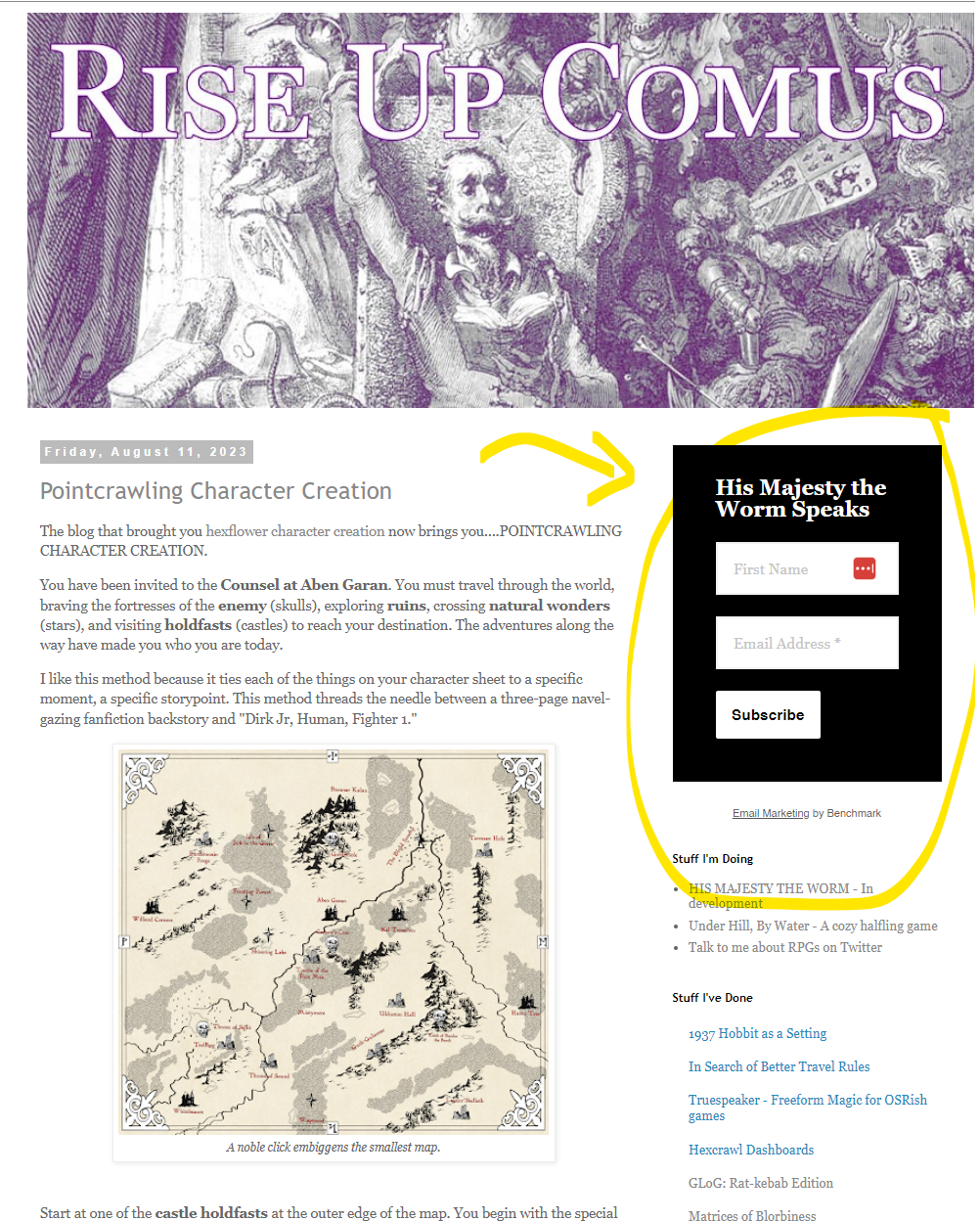
If this sounds interesting and you'd like to check the game out, please sign up for the mailing list in the sidebar of the blog. I will email you to tell you when the game is ready for purchase. 

Sunday, October 8, 2023

Monster Masquerade - a Halloween party game

Here is a party game for Halloween. And when I say party game, I mean party game. This is designed to be played by folks walking around at a party, giving this maybe 10% of their attention.

Print off the different characters. Hand them out at your Halloween shindig.

Monster Masquerade


Rules

Try to accomplish all three of your goals. Some require you to talk to other players. Some require you to scavenger hunt. Not everything you need to find is in the house. In fact, I have no idea if it is or not. 

Some players have special rules that turn you into different creature types. For example, a Frankenstein might kill a human and make that human a ghost. A vampire might make a human into a vampire. 

Ghost Goals

If you are a ghost, possess and buddy up with a living player.  You have to help them achieve their accomplishments. If they win, you win.

Ghosts don’t have any special abilities. You can just provide advice.  

Characters


Vincent St. James

Human Monster Hunter

You are a monster hunter. Can you escape this party alive? 

You know that one of the humans at this party is secretly a werewolf. 

You know that if a vampire or werewolf touches a Coors Light can, or if they drink a Coors Light, that person becomes a ghost.

Goals:
1. Turn two non-humans into ghosts. 
2. Find some garlic, a stake and a mallet. Good vampire killin’ gear.
3. Find at least three pairs of sunglasses. Wear them all at once. Now you look cool. 

Alouicious de’Morte 

Vampire Sensualist 

Nobody has you beat for being a pretentious prick in the Anne Rice tradition. 

Vampire Special Rules: 
  • If a vampire or werewolf touches a Coors Light can, or if they drink a Coors Light, that person becomes a ghost.
  • If a vampire gives a living person a red drink (red wine, red eye, kool-aid, whatever), and they drink it, tell them that they are now a vampire.

Goals: 
1. Compose a melodramatic poem for three other guests and perform it for them.
2. Find and give flowers to your hostess. Thank her gravely for inviting you inside her home. (Don’t steal the flowers from the neighbors.)
3. Make a LiveJournal to fit this persona and make at least one post on it.

Count vonDoom

Vampire Lord

Blah! Come children of the night! Blah!

You know that one of the humans is actually a werewolf. 

Vampire Special Rules: 
  • If a vampire or werewolf touches a Coors Light can, or if they drink a Coors Light, that person becomes a ghost.
  • If a vampire gives a living person a red drink (red wine, red eye, kool-aid, whatever), and they drink it, tell them that they are now a vampire.
Goals:
1. Make allies with the werewolf. Give him your dark mark on his right hand in marker. 
2. Gather your children to you. Find three things shaped like a bat. 
3. Turn at least one human into a vampire. 

Randy Butternubs

Werewolf Cowboy

You are a werewolf. But don’t tell anyone. If anyone asks, say that you are a cowboy.

Special Werewolf Rules: 
  • If you touch a Coors Light can with your skin, or if you drink a Coors Light, you become a ghost.
  • If somebody asks you if you are a werewolf and you are outside at night, you cannot lie. You have to confess to being a werewolf.
  • You can kill a human player by saying “I kill you.” You can only say this if a) You are outside and b) You are absolutely alone.
  • If someone thinks you’re human and tries to kill you, you have to say “This doesn’t work because I’m actually a werewolf.”
Goals: 
1. Kill a human player. This human is now a ghost. They HAVE to possess you. They now win if you win. (None of your other goals can be accomplished by this person.)
2. Be a turncoat. Steal some item that somebody else needs as a goal. That item fulfills this goal for you, now. 
3. Be a skin changer. Change a costume with somebody else. 

Aubrey Frankenstein

Sexy Frankenstein 

Move over Twilight. It’s not just Vamps and Werewolves who are sexy. FRANKENSTEINS CAN BE SEXY TOO. 

Frankenstein Rules: You can kill a human player by saying “I kill you.” You can only say this if you are absolutely alone. That player is now a ghost.

Goals:
1. You are looking for a mate. Get someone to leave a big lipstick mark on your cheek. You are now friends.
2. Make a crude drawing of three other party guests. Give it to them. You are now friends.
3. Kill someone who is your friend. Get Dr. Forester to make them into a Frankenstein. You are now best friends.

J.R. Witherwit

Human Investigator of Eldritch Horror

The horror! The horror!

Goals:
1. Make a “wizard staff” of beer cans. Only this talisman can protect you against the Deep Ones. It has to be at least 5 cans long to count. 
2. Find a fossil. It’s horror calls out for you to make a shrine to it. 
3. Protect three of your friends from MADNESS by drawing an Elder Sign on their right hands with a marker. 

Dr. Forester

Human Mad Scientist

They called you mad? Well, YOU’LL SHOW THEM WHAT MADNESS IS.

Special: If you make a ghost a suicide drink out of 3 different types of drinks and they drink it, they stop being a ghost and become a Frankenstein instead. 

Goals:
1. Make a suicide drink out of 5 different types of drinks. Drink it. It’s a good potion! Mm mm!
2. Make a grave rubbing. You need to keep it for your records. (You’re a grave rubber, not robber)
3. Collect up to 5 hand-held lights (glowsticks, flashlights) that don’t have to be plugged in. 

Monday, August 14, 2023

HIS MAJESTY THE WORM Deep Dive - Speedbumps

Every time I make an announcement about His Majesty the Worm, I declare we are getting close. Then a year goes by. Then I make another announcement. Then another year.

But this time I mean it. We are getting close to print. 


What is His Majesty the Worm? It is a new-school game with old-school sensibilities: the classic megadungeon experience given fresh life through a focus on the  mundanities and small moments of daily life inside the dungeon. 

In the lead up to actually having the book in stores, I'll be doing a series of deep dive blog posts, where I drill into the different parts of the game, wax philosophical about design choices, and talk about my experiences playing it for the past seven years.

Speedbumps


I have a bad memory. GMing is composed of tasks that have a certain cognitive load. Sometimes, while running trad games, I forget a rule detail. "Oh, wait, you were supposed to have disadvantage on that roll since the goblin is higher than you," or "Oh shoot, I forgot that the skeleton is actually immune to necrotic damage. He wouldn't have died from that last blast, huh."

To reduce the number of plates I have spinning while running His Majesty the Worm, the game has procedures that frame the freeform conversations of play. I think about them like speedbumps. Rules that say: Slow down. Don't forget this.

Speedbumps include things like:

  • At the beginning of every game, a chosen player reminds the table about what happened last time. They receive a free point of Resolve for doing this chore. 
  • At the beginning of every Challenge round, the GM reframes the scene, stating what combatants are in which zone, who's doing what, what the players can see, etc.
  • There's a step to confirm that players have tents or bedrolls while sleeping, or else become Stressed.

I talked about this on Twitter with Errant designer Ava Islam. She captured some takeaways in her blog, here. 

To sum up:

"...Consider the role of memory, especially in terms of the cognitive overload demanded of the GM, when designing your rules. Some rules are designed to be fringe and referenced only when needed, but for the core design, think about ways of making sure the rule will actually get remembered at the table."

Basically, the flow of the game has touchpoints that I use to make sure that we all know the current state of things and what's coming next. In play, these procedures makes for a smoother experience that I really enjoy.

Let's dive into two specific examples: Fame and Morale.

Fame


In His Majesty the Worm, players are adventurers in an adventuring guild. Players share a guild sheet, which tracks the stats of the entire party. One of the guild's stats is fame

What is fame?

Fame is the likelihood of whether or not an NPC has heard of the guild, rated 0-5. If their fame is 0, nobody has ever heard of them. If their rating is 5, everybody has heard of them.

How do you track this stat?

I will forget to hand out fame if it was up to GM fiat. Therefore, there is a procedure to set a guild's current fame score when we need it most (just in time resolution): when the guild begins the City Phase.

When the guild enters the City and pays their taxes, the City Phase procedures ask the players to tally their noteworthy deeds and erase the oldest deed from their guild sheet.

Noteworthy deeds are a running list of cool shit the guild has done. Defeating dungeon lords, finding new paths to new levels, curing the petrified people in the basilisk's lair, etc. The guild's fame equals the number of noteworthy deeds on their guild sheet.

Sidenote: Because the game is focused on dungeon crawling, the players are disincentivized to spend time in the City. Because the City Phase obliges you to erase one of your noteworthy deeds, your fame trends down if you come back too frequently without noteworthy deeds.

What does it do?

Fame isn't necessarily good or bad. If the guild's actions are cruel and violent, it's more like infamous. It's just a "Yeah, I've heard of you." When the players encounter NPCs, the roleplaying exchange is framed by whether or not the NPC knows of the guild's exploits. "Yeah, I heard of you. You betrayed the Steel-clad Snakes, I hear. Why should I do you a favor?"

This is the basic way fame is used. But there are some niche uses for it too. 

This brings me to my next point...

Morale

Intelligent creatures do not want to fight to the death. When the going gets tough, they will fallback, retreat, trigger traps, cast the big spells, and try to end the combat. 

When I am running games, I will forget this because there's a lot of stuff going on during combat. Thus, I put in a speedbump by shifting the responsibility from the GM to the players.

In His Majesty the Worm, Morale is a player-facing mechanic (sorta). Let me explain.

Banter

In the Challenge Phase, every player has a hand of cards. They can take actions by spending cards. One action they can take is "Banter." 

When a player Banters, they intimidate, belittle, or taunt an enemy. They add the card's value and (on their turn) their Wands attribute to this action. The target number for the Banter action is an enemy's Morale. 

Here's what the book says about Morale:

Morale is a way to track how confident and self-assured the GM’s characters are in stressful situations. Adventurers don't need to track a Morale rating—it is only for the GM’s characters.

During Challenges, the Banter action is used to affect an enemy’s Disposition. Your Banter value must exceed an enemy’s Morale to successfully change their Disposition. Unlike  Initiative, Morale isn’t determined by cards, but by the situation at hand as determined by the GM.

When Banter is used, the GM makes an assessment of the enemy’s current confidence to determine their Morale. As the battle progresses, the GM should reassess their characters’ Morale score.

Morale is a sliding scale from 8-20, with some common bonuses and penalties to help the GM set the target number. Basically, the GM just walks through a quick checklist: Is 50% of the foe's fighting force down? Is the enemy commander down? Does the guild have a high enough fame for the foes to have heard of them? 

More famous guilds will find their Banter actions are more successful more often because their reputation proceeds them.

Want to learn more about His Majesty the Worm?

If this sounds interesting and you'd like to check the game out, please sign up for the mailing list in the sidebar of the blog. I will email you to tell you when the game is ready for purchase. 


Friday, August 11, 2023

Pointcrawling Character Creation

The blog that brought you hexflower character creation now brings you....POINTCRAWLING CHARACTER CREATION. 

You have been invited to the Counsel at Aben Garan. You must travel through the world, braving the fortresses of the enemy (skulls), exploring ruins, crossing natural wonders (stars), and visiting holdfasts (castles) to reach your destination. The adventures along the way have made you who you are today.

I like this method because it ties each of the things on your character sheet to a specific moment, a specific storypoint. This method threads the needle between a three-page navel-gazing fanfiction backstory and "Dirk Jr, Human, Fighter 1."

A noble click embiggens the smallest map.

Start at one of the castle holdfasts at the outer edge of the map. You begin with the special feature or ability of that holdfast. 

The starting holdfasts are:

  • Willand Corners, the sleepy home of burrowers and rustic men
  • Whitebeacon, capital of the stalwart Ondians, inheritors of the legacy of the First Men
  • Haven Tree, birthplace of the elven folk
  • Baranar Kalan, the deepest delving of the dwarves

You have five seasons to reach Aben Garan. Each season, draw a line to another named point and gain the feature of that location. 

For every season you arrived at Aben Garan early, increase one of your attributes by +1.

The Locations


Baranar Kalan

Long has the Shadow been held at bay by the valor of the dwarves of Baranar Kalan. You have stood with them, fighting the legions of trollspawn beneath the earth and raiding corsairs from the north.

Boon: You gain +2 Attack.

Blood Swamp

Littered with the corpses of armies, fellowships, and travelers foolhardy enough to try to cut through it. In the eerie glow of bioluminescent flora, you are attacked by a bloodwyrm but manage to fend it off. 

Boon: You gain +1d8 HP.

Corsair's Cove

A wretched hive of scum and villainy. You survived here by your wits more than your skill with the blade, as even the mightiest warrior might meet an untimely end in a dark and narrow alley.

Boon: You gain a clever wallet. Your wallet is enchanted with a squeaky voice. If it is ever picked, it will squeal an alarm. If it is ever empty, it will chastise you for being a spendthrift.

Feasting Forest

In the Feasting Forest, the druids ask you riddles in exchange for your life. You answered their questions, and drank from the star-scattered waters of their sacred pool. 

Boon: You gain the ability to Speak with Animals.

Goblinhole

Deep within the depths of Goblinhole, a labyrinth of twisting passages leads to a city where  goblins barter curiosities and trinkets in exchange for stories of the world above. You've traded with them and come out the better for the bargain. They have not forgotten it.

Boon: You gain a goblin bomb. It would be clumsy to use in combat, but you know too well how they can be used to blow open doors, collapse sections of the mine, or cause other destruction.

Guth-Gulaenar

Built to be an impregnable castle. Now, a ruin. You ventured within to learn if it was truly haunted. You found no ghosts, but did find a treasure of ancient days.

Boon: You gain an auroch hunting horn. When blown, members of your fellowship will always hear the call - no matter how far away they are. In the wilds, you have a 2-in-6 chance of attracting outside help. When blown near your home haven, this is a 6-in-6 chance.

Haven Tree

Beneath the towering branches of the Haven Tree, you shelter from the endless march of the outside world. You have learned much from the stories of the elven inhabitants.

Boon: You are a Loremaster. When you bid lore, you may ask a follow up question for free.

Kel Tanenhen

The hilltop home of the brave and honest Free Men, a city-state of humans who self govern. While dwelling among them, you taught them some of your people's crafts. In thanks, they wove you a gift.

Boon: You gain a golden-threaded banner, proudly displaying the arms of your house or realm. When carrying it into battle, you have advantage on attempts to route and drive your foes back.

Lake of Jack in the Green

An elven boatman gives you passage to the island in the center of the emerald lake. Here, you find the ruins of the First Men, and take a cutting of an ancient tree.

Boon: You gain the living tree staff. As long as you carry it, it lives and grows. Wherever you choose to plant it will be blessed indeed.

Landennvein Forge

The Landennvein Forge once boasted the finest dwarven artisans in all the land. The anvil is now is silent. You found some of their ancient material, yet unworked. 

Boon: You gain an ingot of moonsilver. Moonsivler is more precious than gold, for it is both beautiful and useful for all metalcrafts. What will you make this ingot into?

Lautur'Skelleth

Lautur'Skelleth, also known as the Corpsehead Keep, was once the city of necromancers. The sorcerer-kings have now joined their subjects in the lands of the dead. In the shadow of those towers, you plucked an ancient and rare herb

Boon: You have a single leaf of very rare Queensfan herb. Place it on the mouth of one mortally wounded and they will recover if there is even a flicker of life left within them.

Mistymere

Beside the tranquil expanse of the Mistymere, a lone figure contemplates the ripples on the water's surface, their thoughts drifting to distant shores and forgotten tales. You surprised her in her contemplations, and when she saw you had no evil in you, she gave you a gift. 

Boon: You are a Skinchanger. When you put on the swan-feather cloak, you take on the form of a white swan.

Shivering Lake

While fishing on the Shivering Lake, you pulled up a river maiden. She traded you a better net in exchange for her feedom.

Boon: You gain the river maiden's fishing net. It rarely needs mended, and almost always produces a catch.

Tarmaen Hole

Burrowers claim that they once dwelled in Tarmaen Hole, but were forced out by some nameless evil. If those gentle folk ever lived here, the land tells no tale. Nothing green grows here. It is a ruined heath. While passing through these lands, you rescued Windproud the queen of eagles from a tar pit. 

Boon: You have a golden feather of Windproud. If you are ever in need, release the feather onto the wind and she will come to you.

Throne of Sight

The ruins of an Andantine fortress set high on a mountain. After an arduous trek, you beheld a view unrivaled throughout the Wilderlands. You saw many far off places as if they were brought near to you.

Boon: You are Sharp Eyed. You will always act during a surprise round.

Throne of Sound

The ruins of an Andantine fortress set deep in a bowl. Climbing down, many sounds from far way places seemed near at hand. You achieved an understanding most consider uncanny.

Boon: You are Sharp Eared. Once per session, ask the GM for a random rumor.

Tomb of Bandor the Bereft

Bandor was a king of Ond who commanded his wife, his son, his knights, and his entire retinue to be buried with him. This last act of arrogance laid a curse upon the Tomb, as well as the deep valley that surrounds it. You braved only part of the passages beneath the earth, claiming a treasure from the shadows that therein dwell.

Boon: You gain a dagger of star iron. This ancient dagger never needs to be sharpened and always keeps its edge.

Tomb of the First Men

Beside the ancient stones of the Tomb of the First Men, you puzzled over the star signs writ in stone.

Boon: You gain a broken runestone. It is said that the First Men made henges of runestones to travel quickly across the land in ancient times. They are now broken. You have a piece that fits into one of these runestones. If you can find the right henge, perhaps you can make it work one last time?

Trollbog

The trollspawn crawl up from a blight in the very earth itself. You have stood against them for a time.

Boon: You are a Shieldthane. As a maneuver, you may create a shield wall if you have at least two other companions who also carry shields. 

  • The shieldthane “leads” the shield wall. They gain a +2 bonus to their attack roll by being in the shield wall. Other players in the shield wall cannot attack. 
  • Damage done to a shield wall may be split up in any way between the participants. For example, a troll’s hammer dealing 12 damage may be split up as 6 damage to one participant, 3 damage to a second, and 3 damage to a third. You gain 1d8 additional HP. 

Uldvoton Hall

Though an ancient ruin, refugee dwarves are settling here and forming a colony. You trade stories and gear with them.

Boon: You are a Wanderer. You gain 2 pack slots.

Whitebeacon

In the last Age of the world, the Shadow spilled the seas and dried the oceans. The Andantine Isles are now only a ruin and a memory. Whitebeacon is one of the last outposts of this ancient culture: they still tell of heroes, devils, titans, and monsters.

Boon: You are a Dwimmer-crafty. You may combine herbs to cast spells.

Willand Corners

A crossroads town, straight down the King's Highway. Here and here alone is the curious but agreeable custom of human and burrower living together practiced. You have dwelt among them and learned some of their horse sense and wisdom.

Boon: You are a Sneak. At any point, you may declare that you go sneaking. This allows you to go dramatically off-stage. Later, if you are not present in a scene and it’s at least somewhat plausible that you could have snuck there, take 1d4 damage to arrive on the scene dramatically. 

If you go sneaking and all tension evaporates, you may rejoin the scene by slinking out of the shadows. This does not cost HP.

Wispwood

Amidst the whispering trees of Wispwood, fauns and dryads dance in the moonlight, beckoning travelers to join their otherworldly revelry and lose themselves in a realm of enchantment. You did so, and come out changed.

Boon: You are Faun-footed. You have little hooves. You (and everyone you are with) may travel through forest hexes as if they had a road.

Example

Let's make a character together. 


To start, we'll choose a starting castle holdfast. We'll make a burrower because I like little dudes. We'll start at Willand Corners, where burrowers live. We gain the Sneak ability.

(Ostensibly, you could have a burrower character come from any holdfast on the map if you wanted to do a "Character raised by another culture" schtick.) 

Then, we just start connecting the dots as we go towards Aben Garan. We have five stops we could potentially make.

Our first stop is Landennvein Forge. We gain an ingot of moonsilver. Maybe we got the moonsilver ingot by sneaking through the ruins? When game starts, we can trade this as Treasure to an NPC or find an opportunity to forge it into something wondrous.

Our second stop is the Lake of Jack of the Green. We board an elven boat and get a living tree staff. I love that for our burrower. I can just picture a little guy with an over-tall walking staff that's literally growing leaves. I imagine that I want to take it back to Willand Corners and plant it there as a goal, but who can say what will happen during play?

Our third stop is Goblinhole. There, we trick some goblins and get a goblin bomb. Bombs are always useful in play.

We have two more potential stops, but I want some extra attribute points for my guy, so I cut directly towards Aben Garan. Since we arrive two seasons early, we get +2 points to our attributes. We could have taken the long way around, but I'm happy with this character as he is.

Making Your Own Map

You can make your own map with image editing software using the assets provided here. You can add new locations to the map. You can remove these and write wholly original holdfasts, dungeons, etc. 

Leveling Up With Pointcrawling

Why stop at character creation? Use this system to handle character advancement, too. 

After every adventure, you can spend a downtime season to journey to any location on the map and gain the benefits of that place. As you travel, you will find more locations and gain more options!




Sunday, July 30, 2023

Monster Menu Playtest: Dungeon Meshi meets HeroQuest

While between tasks for launching His Majesty the Worm, I found myself with something I haven't had in the last few years: free time. I found being idle uncomfortable, so I made an ashcan of a game that was on my mind: What if HeroQuest could accommodate the storyline of Dungeon Meshi?

I played in a Dungeon Meshi space briefly before, as you might recall

I called this project Monster Menu. I put it onto paper just to get it out of my head. I used a lot of art resources that I had either already purchased or were free to use. I wrote in layout, which is something I've never done before. 

This ashcan version is available to check out. I'd love for you to play it with your friends. If you do, I'd love for you to tell me how it went!

There's a lot of gaps, but I hope you can figure them out. If there's something you don't understand or if something seems weird, just change it. HeroQuest is a game for young folks, and we have grown up. Ride this game hard and put it away wet.

Check out the playtest materials by clicking here or on the picture below.

Click here to check out the playtest materials


Saturday, July 8, 2023

On the Origin of Ents

Despite the inappropriateness of the format, I've made several long threads about Tolkien on Twitter.

As Twitter crashes and burns, I wanted to pull this one out. It's pretty good scholarship, I think.

-----

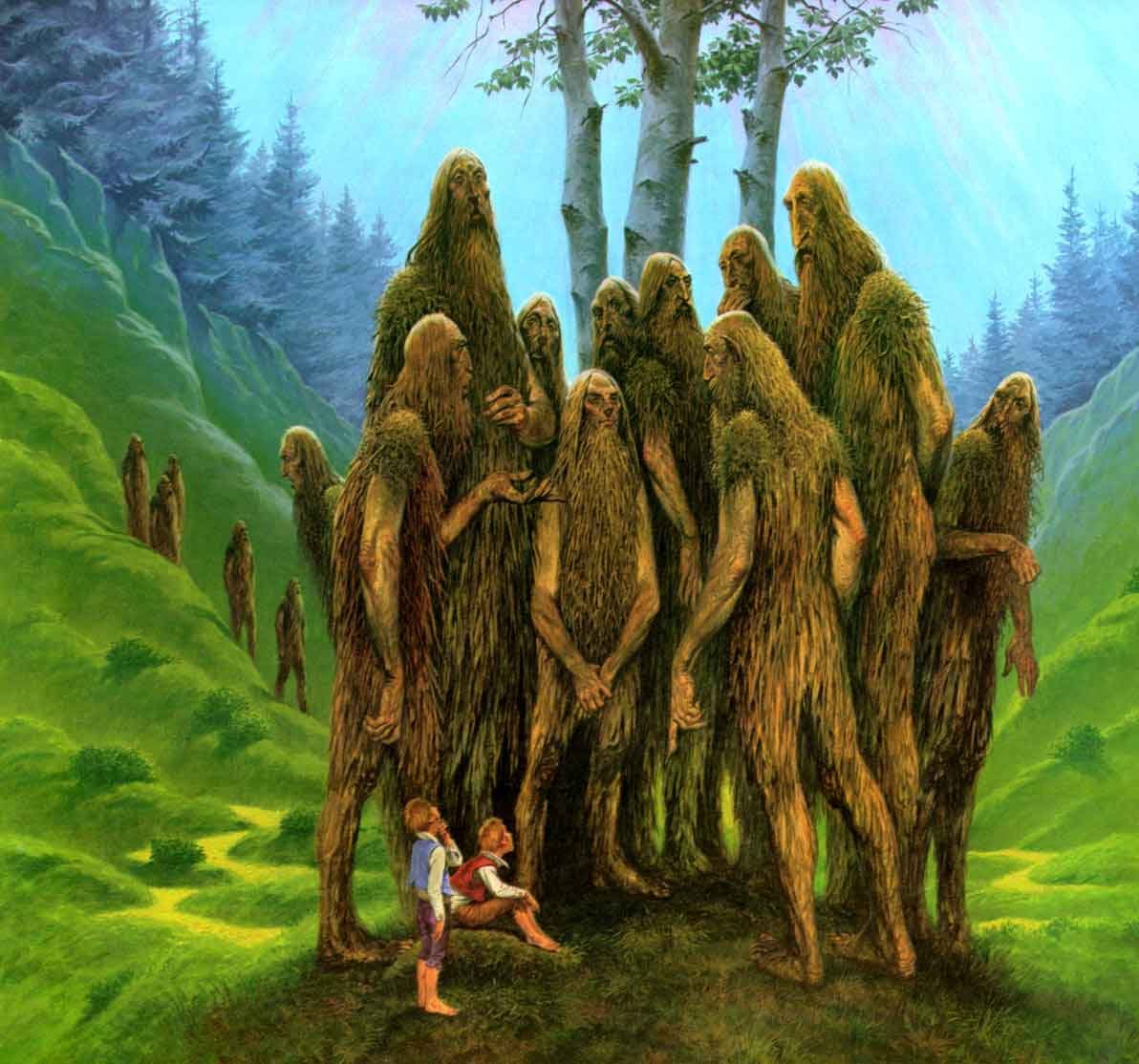
This is my favorite picture of Ents. It is by Darrel Sweet.

Introduction

I want to talk about both the origin of Ents, both within the mythos and also in Tolkien's writing process.

Caveat: Some ascribe a near mythical status to Tolkien, imagining that he had a perfect understanding of the entire corpus of written literature, and that his books were divinely inspired, unerring, and delivered on golden tablets. In truth, he was an ambitious writer who was constantly rewriting. I believe Tolkien would still be tinkering if he could.

One of the reasons that "Where did Ents come from" is a perennial question is because of Tolkien's editorial gaps. If the Silmarillion goes into all this detail about who gets to be Ilúvatar's special boy, what about Ents? If Treebeard is called the oldest creature, what of Tom Bombadil? What of the Elves awakening first? And what are we supposed to do about the connection of ents -> trolls that Treebeard mentions, considering Tolkien was refining his “problem of thinking evil creatures” up until his death?

(For that matter, what are we supposed to do about giants, who are only mentioned in an off-handed passage in The Hobbit?)

In Letter 180, Tolkien writes: "I have long ceased to invent...I have no recollection of inventing Ents...I wrote the 'Treebeard' chapter without any recollection of any previous thought." 

This seems largely true. Here are the accompanying notes to the first draft of Treebeard's appearance from The Treason of Isengard:

Did first lord of the Elves make Tree-folk in order to or through trying to understand trees?

Notes for Treebeard.

In some ways rather stupid. Are the Tree-folk ('Lone-walkers') hnau that have gone tree-like, or trees that have become hnau?

Treebeard might be 'moveless' - but here are some notes [?or) first [? suggestions].

There are very few left. Not enough room. 'Time was when a fellow could walk and sing all day and hear no more than the echo of his voice in the mountains.'

Difference between trolls - stone inhabited by goblin-spirit, stone-giants, and the 'tree-folk'. [Added in ink: Ents.] 

There are some gems in these notes that make my hair stand on end. "Did the first elves make Tree-folk in order to understand trees"? "Hnau"? "Goblin spirits"? 

Let's dig into it.

Elves and the Origins of Ents

If we take him at his word, Legolas can hear the speech of the stones of Hollin: 

“But the Elves of this land were of a race strange to us of the silvan folk, and the trees and the grass do not now remember them. Only I hear the stones lament them: deep they delved us, fair they wrought us, high they builded us; but they are gone. They are gone. They sought the Havens long ago.”

Elves can talk to things, even seemingly unliving things.

Treebeard says as much in The Two Towers: "Elves began it, of course, waking trees up and teaching them to speak and learning their tree-talk. They always wished to talk to everything, the old Elves did."

And here is one of the contradictions between the trilogy and the Silmarillion. The Silmarillion goes into some depth about how speech was evidence of sentience, and sentience can only be given by Ilúvatar. Ipso facto, Ents must have been made by Ilúvatar "off screen."

I think we can accept this lore of the Silmarillion as being an editorial contradiction - because the text of The Hobbit and the trilogy is just full of things that talk: troll purses, foxes watching hobbits sleep, speaking thrushes and ravens, etc.

Needling at the point of elves "creating" Ents, let's look at the rest of the first draft of the Treebeard chapter. Treebeard says: "But it was not so, of course, in the beginning. We were like your Tombombadil [sic] when we were young."

Tom Bombadil is one of those other "problems" about Middle-earth, but I think it's pretty well solved in this passage from The Lost Tales:

And with them came many of the lesser Vali who loved them and (...) these are the Mánir and the Súruli, the sylphs of the airs and the winds.

...

About them fared a great host of sprites of trees and woods, of dale and forest and mountain-side, or those that sing amid the grass at morning and chant among the standing corn at eve. These are the Nermir and the Tavari, Nandini and Orossi, brownies, fays, pixies, leprawns, and what else are they not called, for their number is very great: yet must they not be confused with the Eldar, for they were born before the world and are older than its oldest, and are not of it, but laugh at it much, for had they not somewhat to do with its making, so that it is for the most part a play for them...

In the early days of Tolkien's conception - perhaps during the work of writing the trilogy - Middle-earth was a populous place of fairy spirits, "brownies, fays, pixies." These spirits made the world through the Ainulindalë and dwelled in it because they loved it.

Treebeard saying that he was like Tom Bombadil is telling. If Tom Bombadil is a genus loci, so is Treebeard. Both have the same origins. 

Elves woke up spirits who dwelled in trees to try and understand trees. These spirits are part of the host of "sprites of tree and wood."

Hnau

Tolkien's marginal text is curious here. "Hnau." What is that word? Is it a word from his own conlangs? 

Actually, "hnau" is from C.S. Lewis - it was used in his Space Trilogy to mean "rational species." Earth only has one, but Mars had three. Middle-earth seems to have several.

I love that Tolkien borrows the word here as he's thinking about the origin of "rational species" in Middle-earth, and wondering if Ents qualify.

As an aside, it seems to me that using a fictional word like hnau would put to rest the complaints of folks who object to using the word "race" for fantasy species in roleplaying games.

The Origins of Trolls (and Giants)

In The Two Towers, Treebeard says: "Maybe you have heard of Trolls? They are mighty strong. But Trolls are only counterfeits, made by the Enemy in the Great Darkness, in mockery of Ents, as Orcs were of Elves."

The problem of wholly evil "hnau" (ha ha now I can't stop using the word) was something Tolkien wrestled with until his death. It seems much of fantasy fandom is still noodlin' on it. But we can make some educated guesses based on the text on the relationship of trolls and Ents.

First, the word "ent." In Letter 157, Tolkien shows his work: "As usually with me they grew rather out of their name, than the other way about. I always felt that something ought to be done about the peculiar A. Saxon word ent for a 'giant'— to whom all old works were ascribed."

You see the element "ent" before you meet an ent in the text in a toponym. The Ettenmoors, which the hobbits travel through on the way to Elrond's house, means "Troll moors." They also call them the "troll fells." Etten is derived from ent (in English).

You can see the linguistic association between trolls and Ents and giants. 

If we can imagine that Elves can speak to trees to wake up the Ainur spirits that dwelled within them, we can also imagine that the Enemy could do the same with stone. In fact, "normal thing possessed by an evil spirit" is Tolkien's go-to explanation for all sorts of monsters: werewolves, wargs, vampires, etc.

And if "ent" is derived from giant, and the linguistic element can also be applied to trolls, I don't think it's far out to say that the giants that Bilbo spots playing stone-toss in the valley are probably of the same "sort" of creature. Mountain trolls. Big ones.

Conclusion

Tolkien once joked in a letter that his works had no editorial errors, he was merely given faulty materials because he was translating the work of hobbits and there wasn’t space to clarify everything.

Middle-earth "rings true" to audiences because it has *room* for these sorts of inconsistencies. I think they enrich the text, not detract from it. Overexplaining and over clarifying takes away the feeling of history and mystery. 

Let the giants play in the valleys, I say.